If we let $M$ be the Mandelbrot set on $\mathbb{R}^2$ (specifically the set of points $(x,y)$ such that $x+yi\in M$). I was wondering what happens if we have a ideal drum whose shape is that of the Mandelbrot set, and more generally if we have means to solve a boundary value problem with pathological/fractal boundaries? It seems as though this would be significantly harder than solving a boundary value problem whose boundary is defined by a simple closed-form expression. Are the methods employed here wholly different, or is there a means of cleverly employing simple methods here?
Asked
Active
Viewed 600 times
7

Mark McClure
- 31,496

tox123
- 1,642
-
3I added the "fractal-analysis" tag, which is exactly the subject matter here. – Mark McClure Jun 21 '21 at 01:34
-
1When you say $\mathbb{R}^2$ but then define the space to be made up of the points $x+yi$, do you really mean $\mathbb{C}$? There are some important subtleties here... They are mostly irrelevant with respect to the Dirichlet problem (or, more generally, to the nature of Laplace operators with boundary conditions), but it would be good to be clear. – Xander Henderson Jun 21 '21 at 16:41
-
@XanderHenderson I did mean $\mathbb{R}^2$, largely because I don't actually know any complex analysis, so I figured it would be easier to embed the set in a Euclidean space instead. – tox123 Jun 21 '21 at 17:33
1 Answers
8
Some References
The question you ask is not really amenable to a simple answer, and about the best I can do is offer a list of references with some brief discussion.
To the best of my knowledge, the study of analysis on fractals began in the early 90s with the work of Michel Lapidus and his collaborators. One of the earliest papers (cited in Mark McClure's answer, as well) is Lapidus and Pang, Eigenfunctions of the Koch snowflake domain. The focus of the paper is on obtaining numerical approximations of Dirichlet eigenfunctions along the boundaries of John domains (roughly speaking, a John domain is a path connected set where the paths don't get "to close" to the boundary—these domains may have corners, but not cusps). Their primary example in the paper is the von Koch snowflake.
Related to this is Griffith and Lapidus, Computer Graphics and the Eigenfunctions for the Koch Snowflake Drum. Again, the point of the paper is numerical verification of previous results, but there are some very nice illustrations.
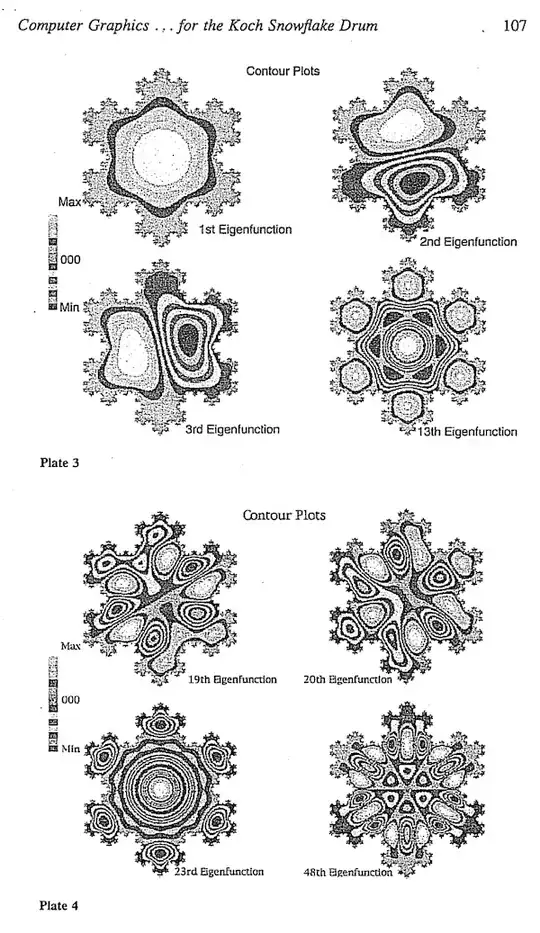
It might also be interesting to know that Michel had approximate von Koch snowflake drums constructed at the time, and was impressed with the way in which the vibrations of the actual drums matched the numerical results. I wish I had a reference for this, but it is based on conversations we had while I was in graduate school. :\
At around the same time (possibly slightly earlier), other researchers and groups were working on the problem of differential equations on fractals (e.g. the domain itself, rather than just the boundary, is fractal). The two most accessible works on this topic (in my opinion) are Jun Kigami Analysis on Fractals, and Robert Strichartz Differential Equations on Fractals. Both have related publications going back (at least) to the early 90s.
I am far from expert from their approach, but the essential idea seems to be that a kind of Laplace operator may be defined on certain fractals which arise as the limit of a sequence of graphs. The core intuition is that harmonic functions are energy minimizing, and so we may construct energy minimizing functions on finite graphs in order to recover the eigenfunctions of a Laplace operator. Assuming that each graph in a sequence is not "too dense" (the technical criterion here is that the limiting fractal set must be "finitely ramified"), it is possible to push these harmonic functions through the limit in order to obtain a Laplace operator on the limiting fractal.
In addition to Kigami and Strichartz, two other names to Google Uta Freiberg and Alexander Teplayev. Both have published on the question of analysis on fractals (again, this is not about what happens when the boundary is fractal, but, rather, what happens with the domain itself is fractal).
More recently, Lapidus has used methods from number theory in order to explore the vibration of "fractal drums." The goto references are his texts Fractal Geometry, Complex Dimensions and Zeta Functions [FGCD] (written with Machiel van Frankenhuijsen) and Fractal Zeta Functions and Fractal Drums [FZF] written with Goran Radunović and Darko Žubrinić).
FGCD deals mostly with the one-dimensional problem: what is the spectrum of the Dirichlet operator on a bounded, open subset of the real line? To such a set Lapidus and van Frankenhuijsen assign a "geometric zeta function", which encodes the geometry of the set. The spectrum of the corresponding Dirichlet operator can then be recovered via (if I recall correctly) some kind of Mellin tranform.
FZF takes this same essential approach, and applies it to bounded sets in $n$-dimensional Euclidean space. The results there are not quite so clean, and a whole zoo of zeta functions is introduced in FZF in order to study the problem, but there are still some results.

Regarding the Mandelbrot Set
I am not an expert on the Mandelbrot set (my interest is that of an educated hobbyist—from a mathematical standpoint, I can point to the Mandelbrot set and exclaim "Oh! Pretty!"), but my impression is that the Mandelbrot set is not the kind of object which is going to be amenable to study using the tools with which I am familiar (basically, the work of Lapidus and his collaborators on "fractal drums").
Most of the results which we can push through rely on self-similarlity. Indeed, we typically require something even stronger than self-similarity: we have analytic tools for describing fractal drums which are the attractors of iterated function systems in which (a) the open set condition is satisfied and (b) the contraction ratios are log-commensurate (that is, if the iterated function system consists of maps with contraction ratios $\{r_j\}$, then there must exist some constant $c$ and a collection of rational numbers $\{q_j\}$ such that for each $j$, $\log(r_j) = q_j c$).
If only the open set condition is satisfied, it is still possible to obtain some numerical results. The essential procedure is outlined in Chapter 3 of FGCD (for the one-dimensional case), and there are ideas in this direction in Chapter 5 of FZF. Other related results are found in papers authored or co-authored by Lapidus (the papers with Helmut Meier and Machiel van Frankenhuijsen are likely the most relevant).

Xander Henderson
- 32,453