9

I am trying to show that for any Lebesgue measurable set of finite positive measure $E$, the characteristic function $\chi_E$ is not in $H^{\frac{1}{2}}(\mathbb{R}^n)$. I found somewhere that it would be enough to show instead that

$$ \int_{\mathbb{R}^n} \int_{\mathbb{R}^n} \frac{\vert \chi_E(x)-\chi_E(y) \vert^2}{\Vert x-y \Vert^{n+1}} dx dy $$

is infinite. I think that the numerator is simply the sum

$$ \chi_{E\times E^c}(x,y)+\chi_{E^c\times E}(x,y) $$ which simplifies the problem to showing that

$$ \int_{E} \int_{E^c} \frac{1}{\Vert x-y \Vert^{n+1}} dx dy + \int_{E^c} \int_{E} \frac{1}{\Vert x-y \Vert^{n+1}} dx dy $$

is infinite, and using Fubini, I think it is enough to show that the first term is infinite. However I am having trouble trying to simplify it further, and think that I should eventually use an integral of the form $\int_1^\infty \frac{1}{r^p}dr$ somehow.

I would appreciate any hints or helpful remarks, including those telling me that this attempt is inherently flawed.

Keen-ameteur
  • 8,404
  • 1
    Change variables, setting $u=x-y, v=x+y$. – Giuseppe Negro Jul 26 '20 at 10:22
  • @GiuseppeNegro I am not sure how to do said change of variables. I am not sure to what set $E\times E^c$ is mapped to. I seem to be struggling more than I should with this. – Keen-ameteur Jul 27 '20 at 05:58
  • You were right, that change of variables was not useful. The Fourier-analytic answer of LL 3.14 is great, but it is also possible to use the Gagliardo seminorm as you thought. I am writing an answer right now. – Giuseppe Negro Aug 01 '20 at 17:24
  • 1
    In the end, all the answers here use the symmetric rearrangement. This is a great tool. However, I have the impression that it is too advanced, and that this problem should have a solution that does not use it. If you ever find such solution, please let me know. Thanks! – Giuseppe Negro Aug 06 '20 at 18:30

2 Answers2

5

So with your method, the difficulty is the fact that you have no knowledge of the set $E$ at which the singularity occurs. However, the $H^{1/2}$ seminorm (the quantity you are trying to compute, that I will denote $\|\cdot\|_{\dot{H}^{1/2}}$) decreases when one takes a symmetric decreasing rearrangement (see e.g. Lemma 7.17 in the book Analysis by Lieb & Loss). Therefore, taking the ball $B$ centered in $0$ with the same measure as $E$, we have that $$ \|\chi_E\|_{\dot{H}^{1/2}} \geq \|\chi_B\|_{\dot{H}^{1/2}} $$ From there, one way could be to use the Fourier transform definition of $H^{1/2}$ and the exact Fourier transform of $\chi_B$ (see e.g. Fourier transform of the indicator of the unit ball). This gives us $$ \|\chi_B\|_{\dot{H}^{1/2}} = \int_{\mathbb{R}^n} |J_{n/2}(|x|)|^2 \,|x|^{1-n}\,\mathrm{d}x = C_d\int_0^\infty |J_{n/2}(r)|^2\,\mathrm{d}x $$ which is infinite since (see https://en.wikipedia.org/wiki/Bessel_function) $$ J_{n/2}(r) = (\tfrac{2}{πr})^{1/2} \cos(r-\tfrac{(n+1)\pi}{4}) + O_{r\to\infty}(\tfrac{1}{r}) $$ Therefore your integral (i.e. the seminorm) is infinite and thus $\chi_E$ is not in $H^{1/2}$.


Remark: If you want to use your computation, from my first equation you can now restrict to a ball and you have $$ \|\chi_B\|_{\dot{H}^{1/2}} = 2\int_{B} \int_{B^c} \frac{1}{|x-y |^{n+1}} \,\mathrm{d}x \,\mathrm{d}y $$ which might be easier to estimate. I suppose one can restrict this integral on a neighborhood of a point of the sphere and then say that the ball is flat near this point to also get estimates on why this integral is infinite?

LL 3.14
  • 13,938
  • 1
    The last integral is infinite, for the reason you say; it is essentially a "pole" of order n+1 on a n-dimensional space. To rigorously prove this, I would change variables $u=x-y, v=x+y$, like I said. Sorry I am so terse – Giuseppe Negro Jul 28 '20 at 18:20
  • 1
    Yes, of course taking the ball with radius $1$, you can write $$ |\chi_B|{\dot H^{1/2}} = C \iint{\substack{|v-u|<1\|v+u|>1}} \frac{1}{|u|^{n+1}},\mathrm{d}u,\mathrm{d}v = C \int_{\mathbb{R}^n} \frac{1}{|u|^{n+1}} \int_{\substack{|v-u|<1\|v+u|>1}} ,\mathrm{d}v ,\mathrm{d}u = C \int_{\mathbb{R}^n} \frac{|\Omega_u|}{|u|^{n+1}} ,\mathrm{d}u $$ where $\Omega_u = {v\in\mathbb{R}^n \text{ st. } |v-u|<1, |v+u|>1}$ – LL 3.14 Jul 28 '20 at 19:23
  • so I suppose that the volume of the area of the set $\Omega_u$ is of size of order $|u|$ when $|u|\to 0$, but I do not know an easy way to prove it, except using formulas for intersections of spheres in $n$ dimension ... With a very naive argument, I could only show that $|\Omega_u| ≥ C |u|^n$, which to small ... (except of course in dimension 1 ...) – LL 3.14 Jul 28 '20 at 19:24
  • 1
    Yes, I suppose it is simpler too, so if someone has the answer I am happy to hear :) – LL 3.14 Jul 28 '20 at 20:50
  • @LL3.14 I am not that strong with the subject of Fourier transform, but can we say that if $\Vert \chi_F-\chi_{F'}\Vert<\epsilon$, then the Fourier transform of $\chi_F-\chi_{F'}$ is bounded by a bound of the sort of $C_1\cdot \epsilon^{C_2}$? Should I want to try and avoid the lemma you mentioned. – Keen-ameteur Jul 29 '20 at 06:42
  • I don't understand your question. What is the norm $|\cdot|$ you are mentioning? Why $C_1 e^{C_2}$? You can just set $C = C_1 e^{C_2}$ ... or do you want to mean something else? There is no lemma here, the part before the remark finishes the proof. I will clarify. – LL 3.14 Jul 29 '20 at 08:00
  • Can you elaborate on the spherically symmetric rearrangement? I can't find Lemma 1.17 on Lieb & Loss (maybe you refer to a different edition; mine is 3rd). Also, I don't think that the standard rearrangement inequalities are directly applicable, so I am curious. – Giuseppe Negro Jul 29 '20 at 13:36
  • Oh yes sorry, this is 7.17, not 1.17. I corrected. At p. 188-189 – LL 3.14 Jul 29 '20 at 13:48
  • Fantastic. Thank you so much. This is a very interesting fact. – Giuseppe Negro Jul 29 '20 at 14:03
  • Indeed, I must agree with you that showing $\lvert\Omega_u\rvert\ge C \lvert u \rvert$ is harder than I thought. Therefore, my first comment is misleading. This happens when I write before checking the details carefully. Sorry. I am thinking at the simplest way to prove this, and if successful I will write an answer. In any case I liked the Fourier approach, with the Bessel function asymptotics, and especially the idea of using the symmetric rearrangement. – Giuseppe Negro Jul 29 '20 at 23:18
  • @LL3.14 There is a leap in the solution where you go from $E$ to a ball $B$. I would like to justify by approximating $E$with an open set, using the fact the Lebesgue measure is a Radon measure, which then in turns contains an open ball. But this means that I should know what the Fourier transform does to the difference. – Keen-ameteur Jul 30 '20 at 09:07
  • No, there is no leap. I am not saying that there is a ball inside $E$ or approximating $E$. I am saying that the symmetric decreasing rearrangement of the set $E$ is a ball: $E^* = B$ with $B$ a ball of volume $|B| = |E|$. And then I use lemma 7.17. Remark that in the notation of Lieb and Loss $|f|_{\dot H^{1/2}}^2 = (f,|p|f)$. – LL 3.14 Jul 30 '20 at 09:17
  • I have added an answer. The point is that we did not actually need the full formula for the intersection of spheres; an approximation to first order is enough, and it is much easier to obtain. – Giuseppe Negro Aug 03 '20 at 12:48
4

This nice question led me to some thoughts, which I am going to write down in this answer.

NOTATION. The letter $C$ will always denote an irrelevant positive constant, whose value can change from line to line.


We are concerned here with the Gagliardo seminorms, which I will denote by $\dot{H}^s(\mathbb R^d)$ in compatibility with LL3.14’s answer, and which can be defined in two equivalent ways (see also this answer); $$ \lVert f\rVert_{\dot{H}^s}^2:=\int_{\mathbb R^d} \lvert \xi \rvert^{2s}\lvert \hat{f}(\xi)\rvert^2\, d\xi =C\iint_{\mathbb R^d\times \mathbb R^d} \frac{\lvert f(x+y)-f(x) \rvert^2}{\lvert y \rvert^{d+2s}}\, dxdy.$$ Here $\hat{f}$ denotes the Fourier transform. We let $$ \omega_f(y):=\int_{\mathbb R^d} \lvert f(x+y)-f(x)\rvert^2\, dx,\quad\text{ so that }\quad \lVert f \rVert_{\dot{H}^s}^2=C \int_{\mathbb R^d}\frac{\omega_f(y)}{ \lvert y \rvert^{d+2s}}\, dy. $$ The heuristic emerging from these formulations is that, for $f\in L^2$, the seminorm $\lVert f\rVert_{\dot{H}^s}^2$ is finite if and only if $\omega_f$ decays sufficiently fast at $0$, which happens if and only if $\hat{f}$ decays sufficiently fast at infinity.


In what follows, we will consider $f=\chi_E$ for some $E\subset \mathbb R^d$. In particular, we let $B$ denote the unit ball. In the nice answer of LL 3.14, the seminorm $\lVert \chi_B\rVert_{\dot{H}^2}$ is studied via the explicit decay rate of $\hat{\chi_B}$. Here we will perform the same analysis, but studying $\omega_{\chi_B}$ instead. This approach is perhaps more adherent to the OP’s initial thoughts.

Expanding the square, we see that $$\tag{1}\omega_{\chi_B}(y)=2\lvert B\rvert -2\lvert B\cap (B-y)\rvert,$$ so we are reduced to study the measure of the intersection $B\cap (B-y)$. As the following crude picture shows,
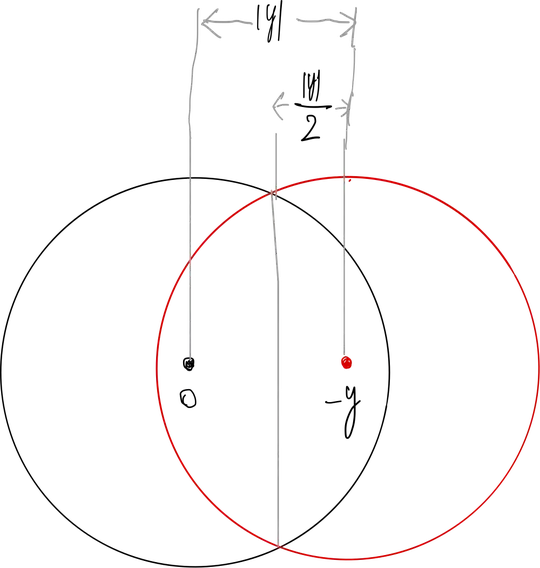
Spherical intersection

such intersection is made of two equal spherical caps. Writing the volume of such caps as an integral, we obtain $$ \lvert B\cap (B-y)\rvert = 2\lvert B^{d-1}\rvert \int_{\lvert y \rvert /2}^1 (1-z^2)^{\frac{d-1}{2}}\, dz.$$ Here $\lvert B^{d-1}\rvert $ denotes the volume of the $d-1$ dimensional ball, but it is not relevant for what follows. Indeed, we do not need an exact expression of $\lvert B\cap B-y\rvert$; an approximation to first order at $y\to 0$ will suffice. To compute such approximation, we note that $$\lvert B\cap (B-y)\rvert \Big\rvert_{y=0}=\lvert B\rvert,$$ and it is clear from the integral that $\nabla_y \lvert B\cap (B-y)\rvert $ exists and it is not zero at $y=0$. We conclude that $$\lvert B\cap (B-y)\rvert =\lvert B\rvert -C\lvert y \rvert + O(\lvert y\rvert^2), $$ which, by (1), gives $$\tag{2} \omega_{\chi_B}(y)= C\lvert y \rvert + O(\lvert y \rvert^2).$$ This is all we need, as it immediately implies that $$ \lVert \chi_B\rVert_{\dot{H}^s}^2= C \int_{\mathbb R^d} \frac{\omega_{\chi_B}(y)}{\lvert y\rvert^{d+2s}}\, dy <\infty \quad \iff \quad s<\frac12.$$


For an arbitrary $E\subset \mathbb R^d$ of finite measure, the result is that $$\lVert \chi_E\rVert_{\dot{H}^s}^2<\infty \quad \Longrightarrow \quad s<\frac12.$$ This follows from the above by the symmetric rearrangement, which gives $\lVert \chi_E\rVert_{\dot{H}^s}\ge C\lVert \chi_B\rVert_{\dot{H}^s}$, as cleverly shown by LL 3.14.

I have tried to bypass the symmetric rearrangement. The above argument would push through if we could show that $$ \omega_{\chi_E}(y)\ge C\lvert y \rvert + O(\lvert y \rvert^2), $$ but I couldn’t find a way to prove this. I don’t even know if this is true, actually.

  • Great! The integral formula for the intersection of caps together with the derivative make quite a good job – LL 3.14 Aug 03 '20 at 17:13