Here's something of a brute-force vector proof.
In the figure, $P$ is a point on our given conic, $\bigcirc K$ of radius $r$ is our given circle, and $A$ is our given point. The tangent line at $P$ meets $\bigcirc K$ at $R$ and $R'$, and the circumcenter of $\triangle ARR'$ is $Q$. Points $A'$ and $K'$ are the respective projections of $A$ and $K$ onto the tangent line. Finally, $a:=|PA|$, $k := |PK|$, and $\alpha$ and $\kappa$ are the (signed) angles made by the tangent line and the respective vectors $\overrightarrow{PA}$ and $\overrightarrow{PK}$.
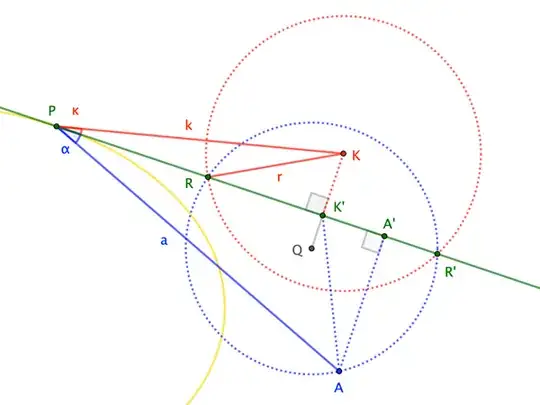
First, a bit of geometry. Ignoring the conic, and concentrating how $\bigcirc K$ meets the tangent line and determines circumcenter $Q$, one can show that $|K'Q|$ is given by
$$\begin{align}
|K'Q| &= \frac{|AK'|^2 -|RK'|^2}{2|AA'|} \tag{1}\\[4pt]
&= \frac{\left(a^2+|PK'|^2-2a|PK'|\cos\alpha\right)-\left(r^2-|KK'|^2\right)}{2a\sin\alpha} \tag{2}\\[4pt]
&= \frac{a^2+k^2\cos^2\kappa-2ak\cos\alpha\cos\kappa-r^2+k^2\sin^2\kappa}{2a\sin\alpha} \tag{3}\\[4pt]
&= \frac{a^2+k^2-2ak\cos\alpha\cos\kappa-r^2}{2a\sin\alpha} \tag{4} \\[4pt]
&= \frac{a^2+k^2-2ak\cos(\alpha+\kappa)-2ak\sin\alpha\sin\kappa-r^2}{2a\sin\alpha} \tag{5}\\[4pt]
&= \frac{|AK|^2-r^2-2ak\sin\alpha\sin\kappa}{2a\sin\alpha} \tag{6}\\[4pt]
&= \frac{|AK|^2-r^2}{2a\sin\alpha}-k\sin\kappa \tag{7}\\[4pt]
&= \frac{|AK|^2-r^2}{2a\sin\alpha}-|KK'| \tag{8} \\[4pt]
\end{align}$$
Therefore, we can write, defining $s := |AK|$,
$$Q = K + (P')^\perp (|KK'|+|K'Q|) = K + \frac{s^2-r^2}{2a\sin\alpha}\,(P')^\perp \tag{9}$$
where $(P')^\perp := (P'_y,-P'_x)$ is perpendicular to $P'$;that is, it's a unit normal to the conic. (We could take either normal. The calculation of $a\sin\alpha$ in $(12)$ ensures that $Q$ is properly offset from $K$.)
Now, to bring the conic back into consideration ... Let us suppose that $P$ lies on an origin-focused conic, with corresponding vertex on the positive $x$-axis, latus rectum $p$, and eccentricity $e$. Then $P$ is parameterized by
$$P = \frac{p}{1+e\cos\theta}\;(\cos\theta,\sin\theta) \tag{10}$$
The unit tangent vector is then
$$P' = \frac1{\sqrt{1+e^2+2e\cos\theta}} (\sin\theta, -(e + \cos\theta)) \tag{11}$$
We also have
$$
a \sin\alpha = (P')^\perp\cdot(A-P) =
\frac{p - A_x(e+\cos\theta) - A_y \sin\theta}{\sqrt{1 + e^2 + 2 e \cos\theta}} \tag{12}
$$
Substituting into $(9)$ we find the locus point $(x,y)=Q$ parameterized as
$$(x,y) = K + \frac{s^2-r^2}{2(p - A_x(e+\cos\theta) - A_y \sin\theta)}(e+\cos\theta,\sin\theta) \tag{13}$$
Separating the components and clearing denominators gives equations that happen to constitute a linear system in $\cos\theta$ and $\sin\theta$; solving and substituting into $\cos^2\theta+\sin^2\theta=1$ gives a second-degree polynomial equation in $x$ and $y$ which necessarily represents a conic.
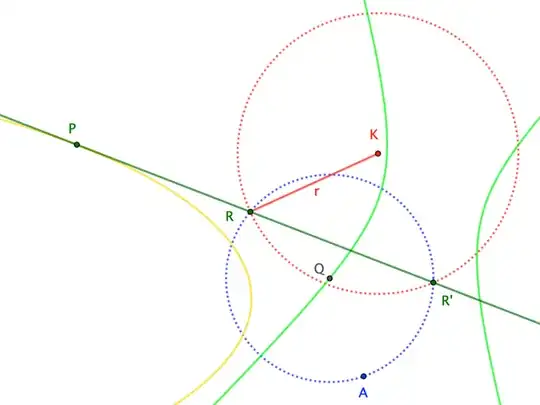
For completeness, the equation is as follows:
$$\begin{align}
0 &= 4 x^2 (p + A_x (1-e)) (p - A_x(1+e))\\
&+ 4 y^2 ( p^2 - A_y^2(1-e^2)) \\
&-8 x y\, A_y (ep+A_x(1-e^2)) \\
&+4 x(A_x (s^2-r^2+2A_x K_x+2A_y K_y) (1-e^2)
+ ep( s^2 - r^2 + 4 A_x K_x + 2 A_y K_y ) - 2 K_x p^2 ) \\
&+4y ( A_y ( s^2 - r^2 + 2 A_x K_x + 2 A_y K_y ) (1-e^2) + 2 ep A_y K_x - 2 p^2 K_y ) \\
&-(s^2 - r^2 + 2 A_x K_x + 2 A_y K_y)^2 (1 - e^2)
- 4 e p K_x (s^2 - r^2 + 2 A_x K_x + 2 A_y K_y)
+ 4 p^2 (K_x^2 + K_y^2)
\end{align} \tag{$\star$}$$
Defining $m^2=s^2-r^2+2(A_xK_x+A_yK_y)=|OA|^2+|OK|^2-r^2$, we can write this as
$$\begin{align}
0 &= 4 x^2 (p + A_x (1-e)) (p - A_x(1+e)) \\
&+ 4 y^2 ( p^2 - A_y^2(1-e^2)) \\
&-8 x y\, A_y (ep+A_x(1-e^2)) \\
&+4 x(A_x m^2 (1-e^2)
+ ep( m^2 +2A_xK_x) - 2 K_x p^2 ) \\
&+4y ( A_ym^2 (1-e^2) + 2 ep A_y K_x - 2 p^2 K_y ) \\
&-m^4 (1 - e^2)- 4 e p K_x m^2+ 4 p^2 |OK|^2
\end{align} \tag{$\star'$}$$
which isn't much of an improvement, but I don't think the equation is the important thing here.
The discriminant (ignoring a factor of $64p^2$) reduces to $|OA|^2 - (p - e A_x)^2$, which indicates that the nature of the resulting conic (ellipse, parabola, hyperbola) depends only upon $A$'s position relative to the focus.


