HINT
$\color{brown}{\textbf{Contour integrals.}}$
Given integral can be presented in the form of
$$I = \int\limits_{C_{\Large_\rightarrow}} f(w)dw + \int\limits_{C_{\Large_\leftarrow}} f(w)dw,\tag1$$
where
$$f(w)=e^{-\alpha w} w^{-(\beta+1)} e^{\large te^{\Large w}},\tag2$$
contour $C_{\Large_\rightarrow}$ is line
$$w=u+i\frac\pi2,\quad\text{where}\quad u = 0 \to\infty.$$
contour $C_{\Large_\leftarrow}$ is line
$$w=u-i\frac\pi2,\quad\text{where}\quad u = \infty \to 0.$$
Let
$$C_{\Large_\uparrow}: w=0+iv,\quad\text{where}\quad v=-\frac\pi2\to \frac\pi2,$$
$$C_{\Large_\rightarrow}(R): z=u+i\frac\pi2,\quad\text{where}
\quad u = 0 \to \ln R,$$
$$C_{\Large_\downarrow}(R): z=\ln R+iv,\quad\text{where}
\quad v=\frac\pi2\to -\frac\pi2,$$
$$C_{\Large_\leftarrow}(R): z=u+i\frac\pi2,\quad\text{where}
\quad u = \ln R\to0.$$
then
$$C_{\Large_\rightarrow} = \lim\limits_{R\to\infty}C_{\Large_\rightarrow}(R),\quad
C_{\Large_\leftarrow} = \lim\limits_{R\to\infty}C_{\Large_\leftarrow}(R),\tag3$$
$$I = \lim\limits_{R\to\infty} I_R,\quad\text{where}
\quad I_R=\int\limits_{C_{\Large_\rightarrow}(R)} f(w)dw + \int\limits_{C_{\Large_\leftarrow}(R)} f(w)dw,\tag4$$
At the same time, the contour
$$C = C_{\Large_\uparrow} + C_{\Large_\rightarrow}(R)+C_{\Large_\downarrow}(R)
+ C_{\Large_\leftarrow}(R)$$
is closed, and there are not special points inside.
Therefore,
$$\int\limits_{C_{\Large_\uparrow}} f(w)dw
+ \int\limits_{C_{\Large_\rightarrow}(R)} f(w)dw
+ \int\limits_{C_{\Large_\downarrow}(R)} f(w)dw
+ \int\limits_{C_{\Large_\leftarrow}(R)} f(w)dw = 0,$$
$$I_R = \int\limits_{C_{\Large_\rightarrow}(R)} f(w)dw
+ \int\limits_{C_{\Large \leftarrow}(R)} f(w)dw
= -\int\limits_{C_{\Large_\downarrow}(R)} f(w)dw
- \int\limits_{C_{\Large \uparrow}} f(w)dw.\tag5$$
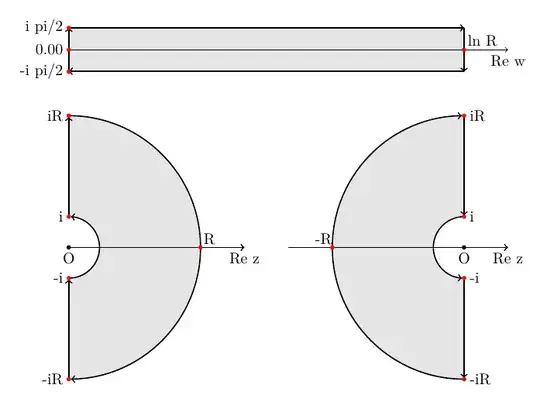
Substitution
$$z=e^w,\quad dw = \dfrac{dz}z$$
provides the equalities
$$I_R = -\int\limits_{D_{\Large_\curvearrowright}(R)}g(z)\,dz
- \int\limits_{D_{\Large_\curvearrowleft}(R)}g(z)\,dz
= \int\limits_{D_{\Large_{\uparrow-}}(R)}g(z)\,dz
+ \int\limits_{D_{\Large_{\uparrow+}}}g(z)\,dz
= -\int\limits_{E_{\Large_\curvearrowright}(R)}g(z)\,dz
- \int\limits_{E_{\Large_\curvearrowleft}}g(z)\,dz, \tag6$$
where
$$g(z) = z^{-(\alpha+1)}(\ln z)^{-(\beta+1)}e^{tz}\,dz,\tag7$$
$$D_{\Large_{\uparrow+}}: z=0+iy,\quad\text{where}\quad y=1\to R,$$
$$D_{\Large_\curvearrowright}(R): z=Re^{i\varphi},\quad\text{where}
\quad \varphi = \dfrac\pi2 \to \dfrac{3\pi}2,$$
$$D_{\Large_{\uparrow-}}(R): z=ye^{\Large \frac{3\pi}2i},\quad\text{where}
\quad y=R\to 1,$$
$$D_{\Large_\curvearrowleft}(R): z=e^{i\varphi},\quad\text{where}
\quad \varphi = \dfrac{3\pi}2\to\dfrac\pi2.$$
$$E_{\Large_\curvearrowleft}: z=e^{i\varphi},\quad\text{where}
\quad \varphi = \dfrac\pi2\to -\dfrac\pi2.$$
$$E_{\Large_{\uparrow-}}(R): z=ye^{\Large -\frac{\pi}2i},\quad\text{where}
\quad y=R\to 1,$$
$$E_{\Large_\curvearrowright}(R): z=Re^{i\varphi},\quad\text{where}
\quad \varphi = -\dfrac{\pi}2 \to \dfrac\pi2,$$
Easy to show that
$$\lim\limits_{R\to\infty} \int\limits_{E_{\Large_\curvearrowright}}g(z)\,dz = 0.$$
Therefore,
$$I = -\int\limits_{E_{\Large_\curvearrowleft}}g(z)\,dz
+ \int\limits_{E_{\Large_{\uparrow-}}(\infty)}g(z)\,dz
- \int\limits_{D_{\Large_{\uparrow-}}(\infty)}g(z)\,dz,$$
$$ = i\int\limits_{\Large\frac\pi2}^{\Large\frac{3\pi}2}\,e^{-i\alpha\varphi}(i\varphi)^{-(\beta+1)}e^{\large te^{\Large i\varphi}}\, d\varphi
+\int\limits_1^\infty \left(\left(\ln y+i{\small\frac32}\pi\right)^{-(\beta+1)} - \left(\ln y-i\frac\pi2\right)^{-(\beta+1)}\right) y^{-\alpha}e^{-ity}\,dy.$$


\largetag when you are building such edifices else it becomes quickly unreadable, especially the exponents. – zwim Apr 07 '19 at 22:19