Much of point-set topology generalizes ideas from real analysis. You'll find continuity restated in terms of open sets so that it can be defined for functions between spaces where a metric doesn't exist (but this generalized definition agrees with analysis' epsilon-delta definition when one does). Likewise, there is a generalized definition for sequence convergence that agrees with analysis in a metric space, but bizarre things can happen outside of one, such as every sequence converging to every point in the space$^\dagger$. You'll also explore specifically which hypotheses we put on a space give rise to different theorems. For instance, in a metric space, we have compactness $\iff$ sequential compactness $\iff$ limit-point compactness. Why is this so? How do these implications change when we remove hypotheses (e.g. when we assume our topological space isn't a metric space, or when we remove the assumption that two points are guaranteed disjoint neighborhoods)? Two theorems you'll recognize from analysis, the Bolzano-Weierstrass theorem and the Heine-Borel theorem, are central to these considerations. So having taken real analysis and encountering things like compactness, continuity, and convergence in a specific kind of topological space (a metric space) makes encountering these concepts in a more general setting easier.
Long story short: real analysis is a sufficient background to get started, and topology is a natural next step.
$^\dagger$ This sort of weirdness made me fall in love with topology. I really can't emphasize this enough—it leads to all sorts of beautiful, often visual constructions.
For instance, here's a connected, locally connected, path-connected, but not locally path-connected subspace of $\mathbb{R}^2$ (source):
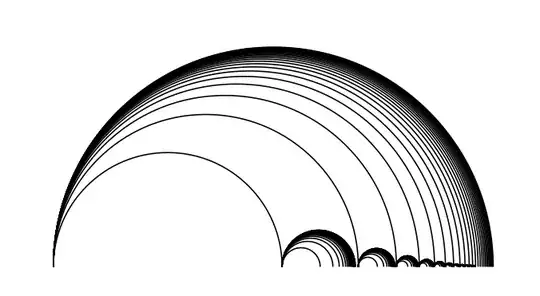
And a choice quotient of this space yields a connected space where removing any point disconnects it into exactly $3$ connected components (source):

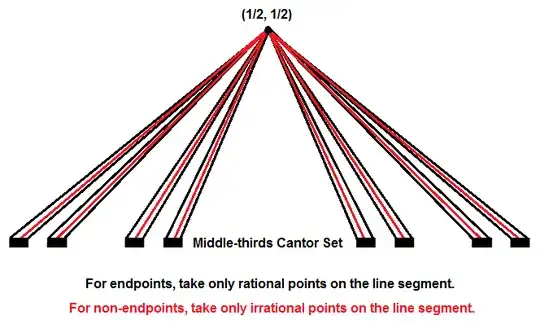
And here's Cantor's leaky tent: a connected subset of $\mathbb{R}^2$ that becomes totally disconnected(!!) upon removing the single point at the tent's apex.