Since
$$x_n=1-\sum_{i=1}^{n-1} x_i,\tag1$$
then required to find the least and the greatest values of
$$F_n(\vec x) = \sum_{i=1}^{n-1} (10x_i^3-9x_i^5)+10x_n^3-9x_n^5\tag2,$$
where
$$\vec x = \{x_1,x_2\dots x_{n-1}\},\quad x_k\ge0,\quad k=1,2\dots n.\tag3$$
The problem of bounds is not actual, because the arbitrary quantity of points can be set to zeros.
$\color{brown}{\textbf{The stationary points.}}$
The stationary points of $F$ can be defined from the system
$$\frac{\partial F_n}{x_k}=0,\quad\text{where}\quad k=1,2\dots n-1,$$
or
\begin{align}
&30(x_k^2-x_n^2)-45(x_k^4-x_n^4) = 0,\quad k=1,2,\dots n-1,\\[4pt]
&(x_k-x_n)(x_k+x_n)(2-3x_k^2-3x_n^2) = 0,\quad k=1,2,\dots n-1.\\[4pt]
\end{align}
If $x_n$ is known, then, taking in account the constraints $(3),$ vector $\vec x$ WLOG can be presented in the form of
$$
\vec x = \left\{\underbrace{\sqrt{\frac23-x_n^2}\dots\sqrt{\frac23-x_n^2}}_{n-m},\underbrace{x_n\dots x_n}_{m-1}\right\},\\[8pt]
m=1\dots n.\tag4
$$
I.e. exactly $m$ unknowns set to $x_n,$ and the other $(n-m)$ set to $\sqrt{\frac23-x_n^2}\,.$
$\color{brown}{\textbf{Case }\quad\mathbf{m=n.}}$
Solution for the inner stationary points is
$$\begin{align}
&\vec x = \left\{\underbrace{\frac1n\dots\frac1n}_{n-1}\right\},\quad x_{n}=\frac1n,\\
&F_n\left(\vec x\right) = \frac{10}{n^2}-\frac9{n^4},\\[4pt]
&\dfrac{\partial}{\partial n}F_n\left(\vec x\right) = \frac{4(9-5n^2)}{n^5},\\[4pt]
&\min_n F_n\left(\vec x\right) = \lim_{n\to\infty} F_n\left(\vec x\right) = 0,\\[4pt]
&\max_n F_n\left(\vec x\right) = \frac{31}{16}\quad\text{at}\quad n=2,\quad x_n=\frac12
\end{align}$$
(see also Wolfram Alpha plot).
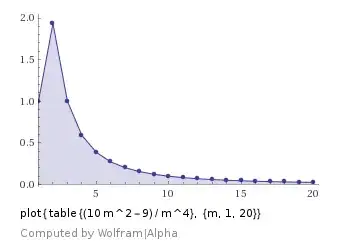
Taking in account the bounds of area, vector $\vec x$ can consist an arbitrary number of zeros instead of $x_n$.
So for the given $n$
$$F_n\left(\vec x\right)\in\left[\frac{10-9n^2}{n^4},\frac{31}{16}\right].\tag5$$
Note that if $n>3$ then $\min F\left(\vec x\right) < 1$ in the inner stationary points.
In paricular, if $n=4$ then $\min F\left(\vec x\right)= \dfrac{151}{256}.$
$\color{brown}{\textbf{Case }\quad\mathbf{m<n.}}$
Let
$$s=n-m,\quad s\ge 1,\tag6$$
then
\begin{align}
&sx_1+mx_{s+m} = 1,
\quad\text{where}\quad x_1=\sqrt{\frac23-x_{s+m}^2},\\[4pt]
&P(x_{s+m},m) = 0,
\quad\text{where}\quad P(x) = 3(mx-1)^2 + s^2(3x^2-2),
\quad mx_{s+m}\le 1,\\[4pt]
&3(m^2+s^2)x_{s+m}^2 - 6mx_{s+m} + 3 - 2s^2 =0,\\[4pt]
&x_{s+m} = \dfrac{3m \pm s\sqrt{6(m^2+s^2)-9\phantom{\big|}}}{3(m^2+s^2)}
= \dfrac{9m^2-6s^2(m^2+s^2)+9s^2}{3(m^2+s^2)(3m \mp s \sqrt{6(m^2+s^2)-9\phantom{\big|}}},\\[4pt]
&x_1 = \dfrac{3m^2+3s^2-3m^2 \mp ms\sqrt{6(m^2+s^2)-9\phantom{\big|}}}{3s(m^2+s^2)}
=\dfrac{3s \mp m\sqrt{6(m^2+s^2)-9\phantom{\big|}}}{3(m^2+s^2)},
\end{align}
and, using the symmetry of $(x_{s+m},x_1)$ by $(s,m),$
$$\begin{align}
x_{s+m} = \dfrac{3m \pm s\sqrt{6(m^2+s^2)-9\phantom{\big|}}}{3(m^2+s^2)} = \dfrac{3-2s^2}{3m \mp s\sqrt{6(m^2+s^2)-9\phantom{\big|}}},\\
\quad x_1=\dfrac{3s \mp m\sqrt{6(m^2+s^2)-9\phantom{\big|}}}{3(m^2+s^2)} = \dfrac{3-2m^2}{3s \pm m\sqrt{6(m^2+s^2)-9\phantom{\big|}}}.
\end{align}\tag7$$
Note.
- $P(0) = 3-2s^2,\quad P\left(\frac1m\right)=s^2,$ so $P(0)\not=0,\quad P\left(\frac1m\right)\not= 1.$
Easy to see that the numerator of $x_{s+m}$ in $(7)$ is negative iff $s=1,$ i.e. $m=n-1.$
Let us consider the case $s=1$ apparently.
$\textbf{Case }\mathbf{n=2,\quad m=1,\quad \dbinom sm = \dbinom11.}$
From $(7)$ should
$$x_2 = \dfrac{3 - \sqrt3}6 = \dfrac1{3 + \sqrt3},\quad x_1 = \frac{3 +\sqrt3}6 =\dfrac1{3-\sqrt3},$$
$$F_2\left(\overrightarrow{\{x_1\}}\right) = 20\dfrac{3^3+3\cdot3^2}{6^3} - 18\dfrac{3^5+10\cdot3^4+5\cdot3^3}{6^5} = \dfrac94.$$
$\textbf{Case }\mathbf{n \ge 3,\quad m=n-1,\quad \dbinom sm \in \dbinom1{[2, \infty)}.}$
From $(7)$ should
$$\begin{align}
&x_{n} = \dfrac{3m - \sqrt{6m^2-3\phantom{\big|}}}{3(m^2+1)} = \dfrac1{3m + \sqrt{6m^2-3\phantom{\big|}}},\\
&x_1=\dfrac{3 + m\sqrt{6m^2-3\phantom{\big|}}}{3(m^2+1)} = \dfrac{3-2m^2}{3 - m\sqrt{6m^2-3\phantom{\big|}}},\\
&\vec x = \left\{x_1,\underbrace{x_n\dots x_n}_{m-1}\right\},\\
&F_n\left(\vec x\right) =\dfrac{30m^6-19m^4+24m^2+1}{(m^2+1)^4}
+\dfrac{8m^7-76m^5+100m^3-32m}{9(m^2+1)^4}\sqrt{6m^2-3\phantom{\big|}},\\
\end{align}$$
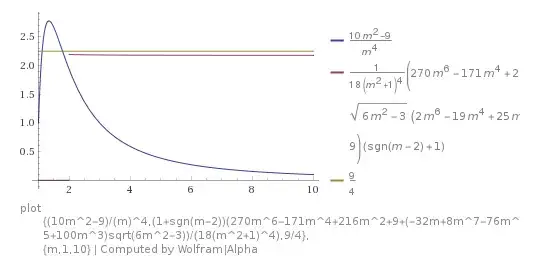
(see also Wolfram Alpha plot),
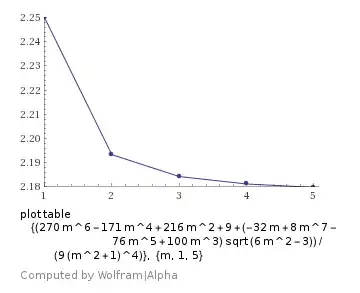
wherein the derivative
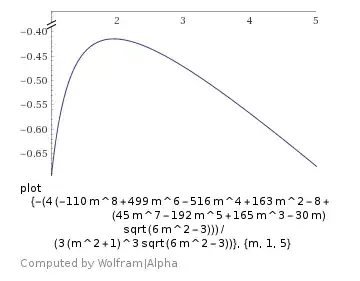
$$\dfrac\partial{\partial n} F\left(\vec x\right) = \dfrac{4(110m^8-499m^6+516m^4-163m^2+8 + \sqrt{6m^2-3\phantom{\big|}}(-45m^7+192m^5-165m^3+30m)}{3(m^2+1)^5\sqrt{6m^2-3\phantom{\big|}}}$$
less than zero $\forall (m\ge2)$
(see also Wolfram Alpha factor plot)
$\textbf{Case }\mathbf{n \ge 4,\quad m=n-s,\quad \dbinom sm \in \dbinom{[2, \infty)}{[n-s, \infty)}.}$
Taking in account $(7)$ and $(4),$ can be written
\begin{align}
&\vec x = \left\{\underbrace{x_1\dots x_1}_{n-m},\underbrace{x_n\dots x_1}_{m-1}\right\},\\
&x_n = \dfrac{3m + s\sqrt{6(m^2+s^2)-9\phantom{\big|}}}{3(m^2+s^2)} = \dfrac{2s^2-3}{s\sqrt{6(m^2+s^2)-9\phantom{\big|}}-3m},\\[4pt]
& x_1=\dfrac{3s - m\sqrt{6(m^2+s^2)-9\phantom{\big|}}}{3(m^2+s^2)} = \dfrac{3-2m^2}{3s + m\sqrt{6(m^2+s^2)-9\phantom{\big|}}},\\[4pt]
&\left[\begin{aligned}
&\begin{cases}
m=0\\
x_1=\dfrac1s
\end{cases}\\[4pt]
&\begin{cases}
m=1\\
x_n = \dfrac{3 + s\sqrt{6s^2-3\phantom{\big|}}}{3(s^2+1)} = \dfrac{2s^2-3}{s\sqrt{6s^2-3\phantom{\big|}}-3}\\
x_1=\dfrac{3s - \sqrt{6s^2-3\phantom{\big|}}}{3(s^2+1)} = \dfrac1{3s + \sqrt{6s^2-3\phantom{\big|}}}
\end{cases}\\[4pt]
\end{aligned}\right.
\end{align}
Easy to see that this case leads to the previous solutions.
$\color{brown}{\textbf{Conclusion.}}$
Therefore,
$$F_n\left(\vec x\right)\in\left\{\dfrac{10}{n^2}-\dfrac9{n^4},\dfrac94\right\}$$
(see also Wolfram Alpha plot).