0

img

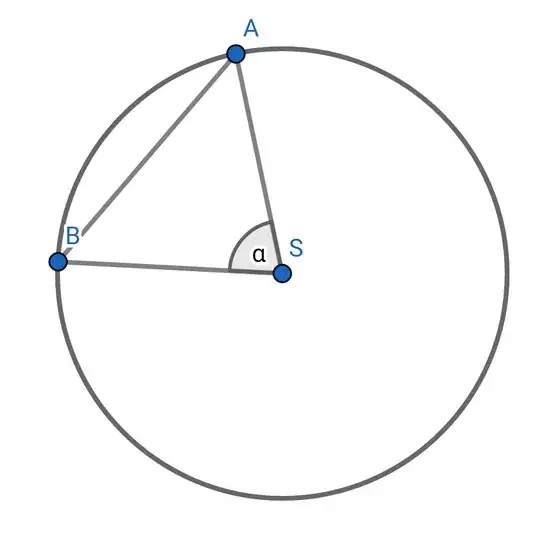
I know the length of the line segment $AB$ and the length od the circle arc $AB$. How can I express the angle $\alpha$ in terms of those two?

I tried many things but I always get some trig function of alpha in terms of itself. I'm not sure if there exist some simple formula, but eiter way any input is appreciated.

jan
  • 489

4 Answers4

1

First notice that $\overset{\frown}{AB}=r\alpha$ where $r$ denotes the radius of the circle. Secondly $$\sin{\frac{\alpha}{2}}=\frac{AB}{2r}=\frac{\alpha AB}{2\overset{\frown}{AB}}$$ therefore $\alpha$ is the solution of: $$\frac{1}{x}\sin{\frac{x}{2}}=\lambda$$ from here we need numerical method to approach $\alpha$

DINEDINE
  • 6,141
1

Since I don't know how to write the symbol for the arc, I'll use the notation $\widehat{BA}$ for the arc.

Let $\frac{\alpha}{2}=k$. As you might know $$\begin{cases} \widehat{BA}=2\pi r·\big(\frac{\alpha}{360°}\big)=2\pi r·\big(\frac{k}{180°}\big) \\ [AB]=\sin\big( \frac{\alpha}{2}\big)·r=\sin(k)·r \end{cases}$$

Dividing $$\frac{\widehat{BA}}{[AB]}=\frac{2\pi k}{180°·\sin(k)}$$ and if you're working with radians $$\frac{\widehat{BA}}{[AB]}=\frac{2k}{\sin(k)}=\frac{\alpha}{\sin(\frac{\alpha}{2})}$$

For which I don't think you'll find further simplifications...

Dr. Mathva
  • 9,003
  • Which means that $k$ is the solution to $\sin(k)/k = {\rm si}(k) = \frac{2[AB]}{\widehat{BA}}$, i.e., one would need an inverse to the sinc function. However, it is known that the sinc function has no simple inverse. – Florian Feb 12 '19 at 16:48
  • Exactly Florian – Dr. Mathva Feb 12 '19 at 16:49
1

Starting from HAMIDINE SOUMARE's answer, you need to solve for $x$ $$\frac{1}{x}\sin{\frac{x}{2}}=\lambda$$ for which, as said, you need some numerical method.

For simplicity, let $x=2y$ and $\mu=2\lambda$ which makes the equation to be $$\sin(y)=\mu\, y$$ which is basically the question I asked here.

To make it short, for $0 \leq y \leq \pi$, you could get quite good estimates using different kind of approximations such as $$\sin(y) \simeq \frac{16 (\pi -y) y}{5 \pi ^2-4 (\pi -y) y}\tag 1$$ or, simpler but less accurate $$\sin(y) \simeq \frac{120}{\pi ^5}(\pi -y) y\tag 2$$ Another one, which is quite good but does not respect the values at the end point $$\sin(y) \simeq \frac{12 \left(\pi ^2-10\right)}{\pi ^3}-\frac{60 \left(\pi ^2-12\right) }{\pi ^4}y+\frac{60 \left(\pi ^2-12\right)}{\pi ^5}y^2\tag 3$$

Approximations $(1)$ and $(3)$ reduce the problem to a quadratic equation in $y$ while Approximations $(2)$ makes the problem to be a linear equation.

Now, if you want to polish the root, using one of these estimates for $y_0$, apply Newton method to iterate according to $$y_{n+1}=\frac{\sin (y_n)-y_n \cos (y_n)}{\mu -\cos (y_n)}$$

Edit

As Yves Daoust answered, for small values of $y$, you could use Taylor series $$\frac{\sin (y)}{y}=1-\frac{y^2}{6}+\frac{y^4}{120}-\frac{y^6}{5040}+\frac{y^8}{362880}+O\left(y^{10}\right)$$ and use series reversion to get $$y=t+\frac{t^3}{40}+\frac{107 t^5}{67200}+\frac{3197 t^7}{24192000}+O\left(t^9\right)\qquad \text{where}\qquad t=\sqrt{6(1-\mu)}\tag 4$$

For example, using $\mu=\frac 12$, the different equations would respectively lead to $y_{(1)}=1.89477$, $y_{(2)}=1.86651 $, $y_{(3)}=1.88030 $, $y_{(4)}=1.89296 $ while the "exact" solution would be $1.89549$.

$y_{(2)}=\pi -\frac{\pi ^5 \mu }{120}$ being the simplest to obtain, let us use it as $y_0$ in Newton method; the following iterates would be produced $$\left( \begin{array}{cc} n & y_n \\ 0 & 1.866510634 \\ 1 & 1.896000423 \\ 2 & 1.895494415 \\ 3 & 1.895494267 \end{array} \right)$$
  • Thanks for this answer! It is very informativne, especally your question about sin(x) = ax. Can x be expressed as an infinite sum or product? I am looking for that, but can't find it. – jan Feb 15 '19 at 17:36
  • 1
    You are welcome ! Equation $(4)$ in this answer can have an inifinite number of terms. – Claude Leibovici Feb 15 '19 at 17:48
  • I see. And just one more thing. Could you explain how you got the inverted series? – jan Feb 15 '19 at 19:18
1

There is indeed no analytical solution, unless youintroduce a special function. With $\beta:=\dfrac\alpha2$, the geometry yields

$$\frac ca=\frac{\sin\beta}\beta=\text{sinc }\beta$$ and you can write

$$\beta=\text{sinc}^{-1}\frac ca.$$

For small angles, by Taylor you have approximately

$$\frac ca=1-\frac{\beta^2}6$$ or to the next order

$$\frac ca=1-\frac{\beta^2}6+\frac{(\beta^2)^2}{120}$$ which are linear and quadratic in $\beta^2$. (Below, the plots of these approximations, $x$ is $\beta^2$. The true curve is in blue.)

enter image description here


The worse error occurs for the half-turn, $2\beta=\pi$, and the approximated values for increasing degrees are

$$0.5887664832879,\\0.6395003848682,\\0.6365198876162,\\0.6366220276468,\\\cdots\\0.6366197723676.$$

Explicit formulas for the polynomial roots are available up to the fourth approximation.