$$f(x) = \log(\sqrt{x^2+1}+x)$$ I can't figure out, why this function is odd. I mean, of course, its graph shows, it's odd, but when I investigated $f(-x)$, I couldn't find way to $-\log(\sqrt{x^2+1}+x)$.
Asked
Active
Viewed 6,460 times
43


-
4$f(x) = \log(\sqrt{x^2+1}+x) = \text{ArcSinh}(x) $ – S L Dec 26 '12 at 18:29
7 Answers
97
If$$f(x) = \log(\sqrt{x^2+1}+x)$$ then $$f(-x) = \log \left(\sqrt{(-x)^2+1}-x\right)=$$ $$= \log \left((\sqrt{x^2+1}-x)\cdot\frac{\sqrt{x^2+1}+x}{\sqrt{x^2+1}+x}\right)=$$ $$= \log \left(\frac{1}{\sqrt{x^2+1}+x}\right)=- \log({\sqrt{x^2+1}+x})=-f(x)$$


19
We have $f(-x)=\log \left(\frac{(\sqrt{x^2+1}-x)(\sqrt{x^2+1}+x)}{(\sqrt{x^2+1}+x)}\right)=\log\left(\frac{x^2+1-x^2}{\sqrt{x^2+1}+x}\right)=-\log(\sqrt{x^2+1}+x)=-f(x)$.

Julien
- 45,674
-
4Interestingly, I had exactly the same answer as Adi Dani one minute before, and I get 9 upvotes while he/she gets 76... – Julien Feb 16 '13 at 20:57
-
8
Another thing to add is that the Taylor series (of odd functions, if it exists) has only odd powers
$$ x-{\frac {1}{6}}{x}^{3}+{\frac {3}{40}}{x}^{5}+\dots.$$

Mhenni Benghorbal
- 48,099
5
This function is another command for showing $f(x)=\text{arcsinh}(x)$ being increasing continous in $[0,\infty]$. We know that $f(x)=\sinh(x)$ is an odd one-one function. $$f(x)=\text{arcsinh(x)}\to \sinh(f(x))=x$$ so if $x\to -x$ then $$\sinh(f(-x))=-x\longrightarrow -\sinh(f(-x))=x\longrightarrow\sinh(-f(-x))=x=\sinh(f(x))$$ so $f(-x)=-f(x)$. This means $f(x)$ is an odd function. There is another different approach for this. See this link http://ddmf.msr-inria.inria.fr/1.8/ddmf
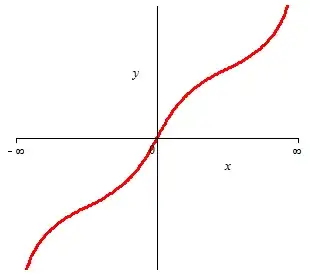

Mikasa
- 67,942
5
To add another hint to Dan's answer, consider that $-\log a = \log \frac1a$ and then simplify the radical out of the denominator for your function.

half-integer fan
- 975
4
Note by differentiating that $$f(x)=\int_0^x \frac{dt}{\sqrt{t^2+1}}.$$ The result now follows from the fact that $\dfrac{1}{\sqrt{t^2+1}}$ is even.

André Nicolas
- 514,336
-
4It is also crucial that the integral start at $0$ and not someplace else. – whuber Dec 26 '12 at 20:53