Quick note, here is the proper statement and a good proof of the chain rule if that's what you wished to find.
As Vim pointed out in your comments, this is the chain rule. I've always thought of it like a tree which may help you grasp it faster.
For instance, consider the function $F\bigg(x\big(u(t),v(t)\big),y,z(t)\bigg)$. This corresponds to the following tree:
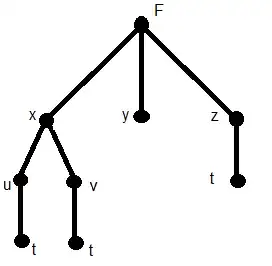
As you see, the child of every vertex represents its "input". Perhaps you want to find $\dfrac{dF}{dt}$. You start at the root $F$ then move over edges to your goal of $t$. Now notice our goal appears multiple times in this tree, so the paths we could take are:
$$\begin{cases}
\ F \to x \to u \to t \\
\ F \to x \to v \to t \\
\ F \to z \to t
\end{cases}$$
Now, consider just the first case above of
$$F \to x \to u \to t.$$
If the vertex you're "on" has more than one child, write it as a partial of the vertex you're on with respect to the vertex you're going to. If it has only one child, then don't use partials. Lastly, multiply all the steps together.
So for instance, our first step is $F \to x$. The vertex $F$ has more than one child, so we write $\dfrac{\partial F}{\partial x}$. Followed by $x \to u$ which provides $\dfrac{\partial x}{\partial u}$. Lastly, the step $u \to t$ is notated as $\dfrac{d u}{d t}$. All in all, for the first case we obtain
$$\dfrac{\partial F}{\partial x} \dfrac{\partial x}{\partial u} \dfrac{d u}{d t}.$$
Now, since we're doing $\dfrac{dF}{dt}$, if that was the only vertex $t$ we would be done and $\dfrac{dF}{dt}$ would be the expression above. But there's two more cases, so let's do those. I expect you see the pattern, so here they are immediately:
$$\dfrac{\partial F}{\partial x} \dfrac{\partial x}{\partial v} \dfrac{d v}{d t}$$
$$\dfrac{\partial F}{\partial z} \dfrac{d z}{d t}$$
The very final step is to add our cases together. So we have the following:
$$\dfrac{dF}{dt} = \dfrac{\partial F}{\partial x} \dfrac{\partial x}{\partial u} \dfrac{d u}{d t} + \dfrac{\partial F}{\partial x} \dfrac{\partial x}{\partial v} \dfrac{d v}{d t} + \dfrac{\partial F}{\partial z} \dfrac{d z}{d t}.$$


