4

This sounds baffling simplistic and I apologize for how naive I sound asking this, but I can't really provide a good explanation for myself as to why this is the case intuitively, other than it just being the way we do math.

But, the way I see it, multiplication is a glorified, repeated form of addition, and that sounds more niche to me; naturally sounding less fundamental and specialized. Yet, when doing math I'm much more happy to deal with multiplication than I am to deal with the stubbornness of addition unless I'm doing calculus. I know why I can simplify equations because of properties of multiplication, but I don't know why they are the way they are and why they tend to be much more lenient than addition despite being a more advanced form of addition, for lack of a better word. It's much easier to put a multiplicative element in a formula in physics than addition, for example, since addition requires both variables being added to have the same units.

Where did this all come to be? If anything about my question needs clarifying, please do comment and ask.

sangstar
  • 1,995
  • 2
  • 21
  • 44
  • 1
    This is more-so meant for whomever answers OP: I'd love to see a group theoretic approach to this – Andrew Tawfeek Aug 01 '17 at 17:47
  • 1
    I'm much more happy to deal with multiplication than I am to deal with the stubbornness of addition. What do you mean by that? Also https://www.maa.org/external_archive/devlin/devlin_06_08.html – user5402 Aug 01 '17 at 17:49
  • @whatever I suppose that statement is over exaggerated and a bit unfair, since the example in my head would be something like $\frac{3x}{6x^2}$ being operable while $\frac{x+4}{x+3}$ is not. So it's more me trying to say I find multiplication tends to have less demanding properties in arithmetic. – sangstar Aug 01 '17 at 17:53
  • 1
    Only in the nonnegative integers is multiplication repeated addition. For arbitrary integers, real numbers, etc. it is a distinct but closely related operation (it distributes over addition). – Matt Samuel Aug 01 '17 at 17:55
  • That's obvious because division is the inverse operation of multiplication. Also $(3+x)-(6-2x)$ is "operable" but $\frac{3+x}{6-2x}$ isn't. – user5402 Aug 01 '17 at 17:55
  • @MattSamuel Interesting.. but if multiplication has different definitions for different sets of numbers, how do we actually define it generally? – sangstar Aug 01 '17 at 17:55
  • Perhaps you're looking for https://en.wikipedia.org/wiki/Ring_%28mathematics%29 – Matt Samuel Aug 01 '17 at 17:57
  • @sangstar Did you complete any abstract algebra course? – user5402 Aug 01 '17 at 17:59
  • @whatever No, I haven't been able to take one in school yet, although it's becoming clear to me that I should. – sangstar Aug 01 '17 at 18:01
  • I don't think abstract algebra has much to do with OP's question, but I am still not 100% clear on the question: is it motivated by the fact that we can multiply quantities of different dimensions (e.g. "Newton meter" is a fine unit, but "Newton + meter" isn't)? Anyway, I am not sure I see how generic ring properties tells you much about arithmetic with real numbers, although I wonder whether "arithmetic with real numbers" is really the direction in which the question is meant to go. – pjs36 Aug 01 '17 at 18:06
  • 1
    @pjs36 "is it motivated by the fact that we can multiply quantities of different dimensions (e.g. "Newton meter" is a fine unit, but "Newton + meter" isn't)?" That's pretty much what I'm trying to get at in my question. – sangstar Aug 01 '17 at 18:08
  • @pjs36 Look at the answer. It uses abstract algebra. – user5402 Aug 01 '17 at 18:08
  • I'm kind of looking for a definition using abstract algebra, and how that addresses how "Newton meter" is fine and Newton + meter is not fine, bluntly. – sangstar Aug 01 '17 at 18:10
  • Maybe this is a bit circular but I think the fundamental reason you are more comfortable with, say, $3x$ than $3+x$ is that you are interested in properties of $x$ as it scales by multiplicative factors, not by additive factors, and combining all terms by the same operation is simpler than mixing operations. That is, $3x$ is simpler because of the problem domain, not because of intrinsic properties of multiplication or addition. – Reinstate Monica Aug 01 '17 at 18:13
  • @sangstar Newton+meter is not fine because it doesn't make sens. Physicists use Newton*meter for torque. https://en.wikipedia.org/wiki/Dimensional_analysis – user5402 Aug 01 '17 at 18:13
  • At any rate, here is a nice related question with more nice linked related questions (esp. the one Bill Dubuque points to). When I said that abstract algebra wasn't relevant, it would have been more accurate to say that the definition of an algebraic structure alone wasn't likely to be very revealing. – pjs36 Aug 01 '17 at 18:21
  • There may be an interpretation of this in terms of typed programming languages, where $(+) :: T\to T\to T$ where $T$ is some type. Then $(\times):: A\to B\to (A\times B)$, where $A\times B$ is the product type. – Mark Schultz-Wu Aug 01 '17 at 18:24

1 Answers1

1

Firstly, the operations of addition and multiplication are just binary operators, that is an operator say, $\#$, that works on any two elements out of a mathematical set, $S$.

We can say that those two elements $a,b \in S$, are in the set and can be operated on $a\; \# \;b$ to get another $c \in S$. This property, of taking a binary operation on two elements of a set to get another element of a set is the fundamental axiom of what we call a group. There are infact other properties that $\#$ must have to qualify for a group, notably there must be some $e \in S$ that $a\; \# \;e = e \; \# \; a = a$, and inverses that exist. However, you can look into that more on your own.

Back to your original question, addition and multiplication as you describe them, are simple two binary operations that have come to mean a whole lot to the world as a whole as they generally do a good job at combining numbers we observe in every day life.

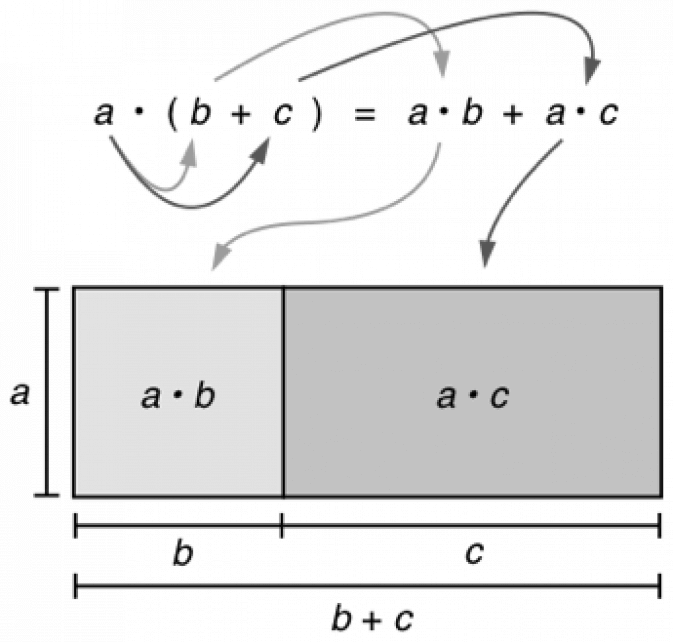
The property you describe as "ease" of multiplication I assume is in large part due to its distributivity, as both multiplication and addition are communities (the order of the elements being operated on does not matter) and associate (the order of successive calls of the operator does not matter). Which I should note, these properties, especially commutativity are rare and special to come by!

As multiplication is in fact a shorthand to express addition, distributivity can be "proved" as follows:

$$(a+b)*(c) = \sum^{c}_{1}{a+b} = \sum^{c}_{1}{a} + \sum^{c}_{1}{c} = a*c + b*c. $$

I also quite like this picture

This property is in large part why it is so much easier to deal with values as you describe in physics, where simplification in large part is due to the grouping and solving of sub expressions that can be most readily extracted out using distributivity.

I also suggest you ponder over further opertators that are extensions atop multiplication themselves! Such as exponent, $2^3 = 2*2*2$, or even the awesome arrow notation, $2 \uparrow \uparrow 3 = 2^{2^2} $.

It is a simple question, but one at the heart of abstract algebra and number theory, two topics that would appear to interest you. Rings, groups, fields, and on! I hope this helps.

Nucl3ic
  • 555
  • This helped a lot. I'm going to start trying to learn those disciplines as soon as I can. Thanks very much. – sangstar Aug 01 '17 at 18:09