This question "Why does(...)" can only be answered by Collatz himself or by research in his mathematical notes.
Let's see what Lagaraias (in his overview)$\;^{(1)}$ has to say:
2. History and Background
The 3x+1 problem circulated by word of mouth for many years. It is generally
attributed to Lothar Collatz. He has stated ([14]) that he took lecture courses in
1929 with Edmund Landau and Fritz von Lettenmeyer in G¨ottingen, and courses
in 1930 with Oskar Perron in Munich and with Issai Schur in Berlin, the latter
course including some graph theory. He was interested in graphical representations
of iteration of functions. In his notebooks in the 1930’s he formulated questions on
iteration of arithmetic functions of a similar kind (cf. [58, p.3]). Collatz is said
by others to have circulated the problem orally at the International Congress of
Mathematicians in Cambridge, Mass. in 1950. Several people whose names were
subsequently associated with the problem gave invited talks at this International
Congress, including H. S. M. Coxeter, S. Kakutani, and S. Ulam.(...)
(Enhancing by me) It means, Collatz worked with various problems of this type, and specifically the version $3x+1$ he disseminated to collegues as being a difficult one.
This is just a short peeking into one reliable source, but by his references "[14]", "[58]" there should be answers with more detailed reasons possible here (I don'thave the book myself) ... P.s. such an information should surely be made available in the wikipedia-entry, if it is not yet there (didn't check it)
update Here is a screenshot from Lagarias' 1985 survey which gives again a bit more background, but I'd say your question "why..." needs even more specific details in its answer...
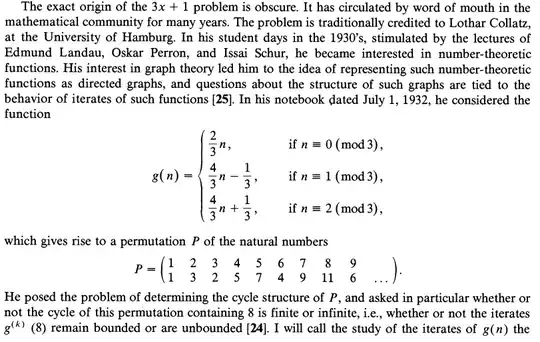
(from $\;^{(2)}$ )
$\;^{(1)}$ Lagarias, Jeffrey C.,
The (3x+1) problem: an overview, Lagarias, Jeffrey C. (ed.), The ultimate challenge. The (3x+1) problem. Providence, RI: American Mathematical Society (AMS) (ISBN 978-0-8218-4940-8/hbk). 3-29 (2010).
ZBL1253.11036.
$\;^{(2)}$ Lagarias, Jeffrey C., The (3x+1) problem and its generalizations, Am. Math. Mon. 92, 3-23 (1985). ZBL0566.10007.


