If so, what would be the most efficient algorithm for generating spheres with different number of hexagonal faces at whatever interval required to make them fit uniformly or how might you calculate how many hexagonal faces are required for each subdivision?
Asked
Active
Viewed 3.0k times
46


-
1CoryG: I've responded to the title question in my answer. For a reasonable approximation using pentagons and hexagons, look at @pjs36's link to Goldberg polyhedra in the comments to my answer. – Brian Tung Jan 31 '17 at 00:33
-
9Consider a sphere with a hexagon drawn on it. This surface is spherical along with two faces, both of which have six edges and six vertices. Yes? – Agnishom Chattopadhyay Jan 31 '17 at 05:09
-
1@AgnishomChattopadhyay: See the comments below my answer for more thoughts on this suggestion (made independently by DavidK). – Brian Tung Jan 31 '17 at 17:45
3 Answers
75
No, not even if we permit non-regular hexagonal faces. (We do, however, preclude hexagons that are not strictly convex—where interior angles can be $180$ degrees or more—since those permit degenerate tilings of the sort David K mentions in the comments.) The reason is more graph-theoretical than geometrical.
We begin with Euler's formula, relating the number of faces $F$, the number of vertices $V$, and the number of edges $E$:
$$ F+V-E = 2 $$
Consider the faces meeting at a vertex. There must be at least three of them, since it is not possible in a solid for only two faces to meet at a vertex.* Thus, if we add up the six vertices for each hexagonal face, we will count each vertex at least three times. That is to say,
$$ V \leq \frac{6F}{3} = 2F $$
On the other hand, if we add up the six edges for each hexagonal face, we will count each edge exactly twice, so that
$$ E = \frac{6F}{2} = 3F $$
Substituting these into Euler's formula, we obtain
$$ F+V-E \leq F+2F-3F = 0 $$
But if $F+V-E \leq 0$, then it is impossible that $F+V-E = 2$, so no solid can be composed solely of hexagonal faces, even if we permit non-regular hexagons.
*ETA (2022-05-17): This is a concession to geometry; the argument isn't strictly graph-theoretical. If you permit situations where only two faces meet at a vertex, then it is possible to create a polyhedron with only hexagons. For instance, start with a cube, and describe a circuit around the faces. (One such circuit goes along the faces of an ordinary die in numerical order.) Then on the edge adjoining two faces in this circuit, add an additional vertex in the middle. Each face will have two new vertices, converting each square into a "hexagon" of sorts. But I think most people would agree this isn't a very interesting positive response to the original question.
If we now restrict ourselves to regular faces, we can show an interesting fact: Any solid with faces made up of nothing other than regular hexagons and pentagons must have exactly $12$ pentagons on it (the limiting case being the hexagon-free dodecahedron).
Again, we begin with Euler's formula:
$$ F+V-E = 2 $$
Let $F_5$ be the number of pentagonal faces, and $F_6$ be the number of hexagonal faces. Then
$$ F = F_5+F_6 $$
The only number of faces that can meet at a vertex is three; there isn't enough angular room for four faces to meet, and as before, solids can't have only two faces meet at a vertex. If we add up the five vertices of each pentagon and the six vertices of each hexagon, then we have counted each vertex three times:
$$ V = \frac{5F_5+6F_6}{3} $$
Similarly, if we count up the five edges of each pentagon and the six edges of each hexagon, then we have counted each edge twice, so
$$ E = \frac{5F_5+6F_6}{2} $$
Plugging these expressions back into Euler's formula, we obtain
$$ F_5+F_6+\frac{5F_5+6F_6}{3}-\frac{5F_5+6F_6}{2} = 2 $$
The $F_6$ terms cancel out, leaving
$$ \frac{F_5}{6} = 2 $$
or just $F_5 = 12$.
I've heard tell that any number of hexagonal faces $F_6$ is permitted except $F_6 = 1$, but I haven't confirmed that for myself. The basic line of reasoning for excluding $F_6 = 1$ may be as follows: Suppose a thirteen-sided polyhedron with one hexagonal face and twelve pentagonal faces exists. Consider the hexagonal face. It must be surrounded by six pentagonal faces; call these $A$ through $F$. Those pentagonal faces describe, at their "outer" edge, a perimeter with twelve edges and twelve vertices, which must be shared by a further layer of six pentagonal faces; call these $G$ through $L$.
There cannot be fewer than this, because the twelve edges are arranged in a cycle of six successive pairs, each pair belonging to one of $A$ through $F$. No two faces can share more than one edge, so the twelve edges must be shared amongst six faces $G$ through $L$, but "out of phase" with $A$ through $F$.
However, these pentagonal faces $G$ through $L$ cannot terminate in a single vertex—they would have to be squares to do that. Hence, they must terminate in a second hexagon. Thus, a polyhedron of the type envisioned cannot exist.
Likely the above approach could be made more rigorous, or perhaps there is a more clever demonstration.

Brian Tung
- 35,584
-
2Similarly, one can show that a solid composed of only square and hexagonal faces must have exactly six square faces. – Brian Tung Jan 30 '17 at 18:26
-
1Are you sure regularity of hexagons is required, or even possible? I'm thinking of these Goldberg polyhedra; I think it's purely combinatorial, coming from $V - E + F = 2$ alone. EDIT: Ah, I see where regularity is used. Sorry about that! I'll still link to Goldberg polyhedra, 'cause they're cool :) – pjs36 Jan 30 '17 at 18:53
-
4@pjs36: No, you're right; strictly speaking, they don't need to be regular. We just need to cap the number of faces meeting at a vertex to three. – Brian Tung Jan 30 '17 at 19:09
-
I'm lost. Since when could it even be considered a possibility that a sphere could be composed of polygons? What definition of a "sphere" are we using here? Perhaps a link would be in order; the question is only tagged "geometry." – Wildcard Jan 30 '17 at 22:56
-
1@Wildcard: I understood the OP to be speaking of a polyhedron. Note that I refer in my solution simply to a solid, not a sphere. – Brian Tung Jan 30 '17 at 23:07
-
2@Wildcard: Of course a sphere can be composed of spherical polygons. For example take a platonic solid and project it from the center onto the enclosing sphere. Although I think he simply meant an object whose vertices are all located on a sphere. – celtschk Jan 30 '17 at 23:27
-
@celtschk, "an object whose vertices are all located on a sphere"—this makes perfect sense; thank you. "...spherical polygons..."—what on earth is that supposed to mean? Ah, I see; you mean "formed on the surface of a sphere." Now the question makes sense. – Wildcard Jan 31 '17 at 00:41
-
4If you admit partitions of the sphere that do not have corresponding polyhedra, a simple partition into two spherical hexagons is to put six vertices around a great circle and connect them with the obvious arcs of the great circle. You can even displace alternating vertices to opposite sides of the great circle if you want "real" vertices, although that makes the hexagons non-convex. You can insert additional hexagons by dividing a hexagon in two by connecting opposite vertices with a three-edge path. This isn't very "uniform", however. – David K Jan 31 '17 at 02:07
-
1@pjs36, and here is a pretty nice site about them! – J. M. ain't a mathematician Jan 31 '17 at 04:35
-
@BrianTung Thanks, this is what I was looking for, you were right in that I was thinking of a polyhedron - my background is in computing and physics not math (the math is something I only really delve into for graphics programming and experiments.) I appreciate the leniency in interpreting the terminology used. – CoryG Jan 31 '17 at 08:35
-
I guess by a "solid" you mean a convex body, right? Otherwise I don't see why your argument that "the only number of faces that can meet at a vertex is 3" is valid. – Andrei Smolensky Feb 01 '17 at 11:07
-
Can you run those numbers again, only this time with octagons as the primary component of the sphere? – Daniel Sep 18 '18 at 18:39
10
If a compromise is acceptable, the $2p, 4p, 8p, ... $ subdivisions of each side of an icosahedron in Buckminster Fuller domes leave behind 12 pentagons at each of its 12 vertices.
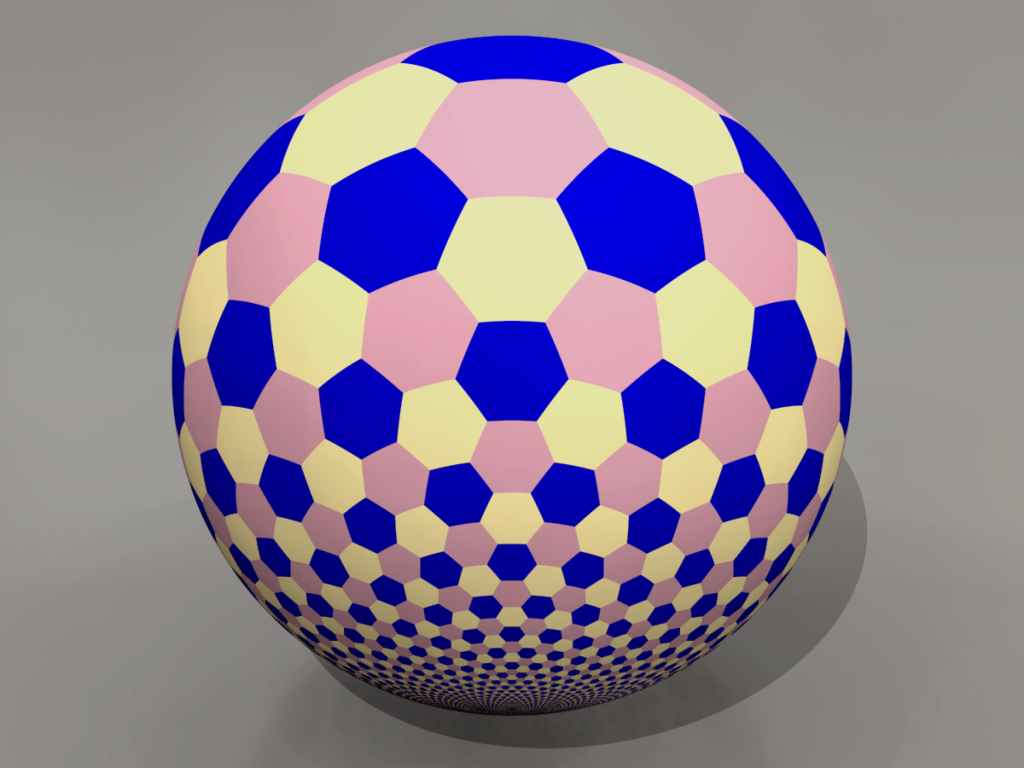
Else, possible by means of a stereographic projection of a flat regular hexagonal net (a node of which touches south pole and other nodes/junctions connect to north pole), the curvilinear hexagon boundary cells shrink to zero towards north pole according to standard stereographic scaling. They can be seen on POV Ray image provided by user PM 2Ring below. A part of spiral has been traced connecting opposite vertices of some hexagons.

It is a collection of log spirals centered at south pole that isogonally ( i.e., conformally) project to rhumb-lines (loxodromes constant inclination to meridians at $\pm \pi/6$) with corresponding latitude circles drawn. I could make an image later if you wish to see. Since these loxodromes are not overtly seen on the above image, some segments are indicated across some hexagon diameters.

Narasimham
- 42,260
-
1Speaking of stereographic projections, here's a mapping of a hexagonal net onto the Riemann sphere, rendered using POV-Ray: RiemannHex – PM 2Ring Feb 01 '17 at 12:55
-
-
0
You can do it if you allow your sphere to have a hole through it, i.e. be a torus. See image here. Then the Euler characteristic, as described in Brian Tung's excellent answer is 0, not 2.
You might also be able to do it for non-convex polygons; convexity is a requirement of the Euler characteristic. See, e.g., the octahemioctahedron. I couldn't find one with just hexagons though.


-
20
-
Am I correct in assuming anything that tiles a plane can tile a torus and vice versa? Would that hold for anything with Euler characteristic 0? – JollyJoker Jan 31 '17 at 11:11
-
1@JollyJoker: I'd think that it would be hard, if not impossible, to use Penrose tiles to cover a torus. Anything that covers a torus should be able to cover the plane, though, as the torus can be viewed as the plane with periodic identifications made; basically, you can unwrap the torus into a rectangle and clone it to cover the plane. – Michael Seifert Jan 31 '17 at 14:28
-
@MichaelSeifert Right, a tiling of the torus obviously must be periodic and non-periodic plane tilings exist. Thanks, I learned something! – JollyJoker Jan 31 '17 at 15:29
-
1Technically this is is a tiling of the punctured sphere - the point at the north pole is missing, and does not have a defined color. – brainjam May 17 '22 at 18:25