Consider integrating the following function of a complex variable, $z$,
$$ f(z)=\frac{z e^{irz}}{\sqrt{z^2+m^2}}, $$
around the contour
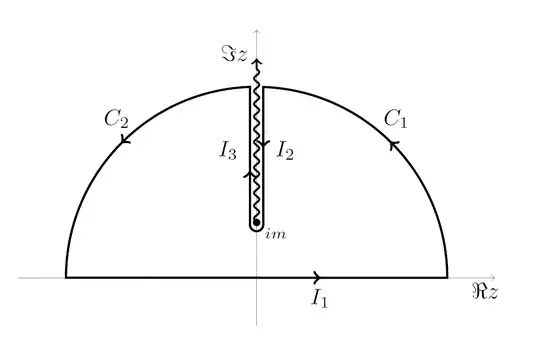
It seems straightforward to show that the infinite radius arc segments, $C_1$ and $C_2$, vanish and we are left with
$$ 0=I_1+I_2+I_3, $$
via the residue theorem. Now, I expect that the integrals along each side of the branch cut which runs from $im$ to $i\infty$ will differ "by a phase" so that they will add together rather than cancel. However, I don't see how to show this explicitly:
\begin{align} I_2 & = \int^m_\infty \frac{Re^{i\pi/2}}{\sqrt{R^2e^{i\pi}+m^2}}e^{irRe^{i\pi/2}}e^{i\pi/2}dR \\ & = \int^\infty_m \frac{R}{\sqrt{-R^2+m^2}}e^{-rR}dR \\ \end{align}
But
\begin{align} I_3 &= \int^\infty_m \frac{Re^{i3\pi/2}}{\sqrt{R^2e^{i3\pi}+m^2}}e^{irRe^{i3\pi/2}}e^{i3\pi/2}\\ &= -\int^\infty_m \frac{R}{\sqrt{-R^2+m^2}}e^{rR}dR, \end{align} so it appears $I_2\ne I_3$ which I believe to be wrong.


