There are four sections. The theorem, the intuition, a proof, and discussion.
Theorem
The theorem should be stated,
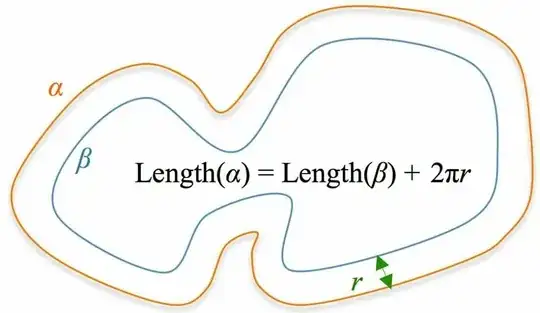
The length of a closed curve $A$ equals the length of $B+2\pi r$ if there is a one to one correspondence between the normal vector intersections. In other words, all the normal vectors of the curve $B$, which is contained in $A$, intersect a point on $A$. The first part of $A$ that it intersects, is denoted $A_i$. The unit normal to $A_i$ also intersects a point on $B$ denoted $B_i$. There is a one to one correspondent between $A_i$ and $B_i$. If the length of all vectors from an arbitrary $A_i$ to $B_i$ are equal to some value $r$,
$$L(A)=L(B)+2\pi r$$
A and B should also be closed and differentiable.
Intuition
This is easy to prove for the case $r=0$ since $A=B$ must be true.
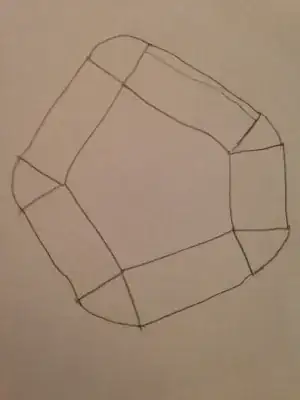
It's also worth noting that the curves A and B can be stretched or transformed into circles, with invariant perimeters and invariant r, by a function $F(X)$. Imagine stretching the curves in the top picture into circles if you are unclear what I meant. This trivially proves the theorem, if the existence of such a function is proven. In general, this is guaranteed by the differentiability of the curves and by the property that they are closed. The invariance of r can be shown by the original assumptions I presented for the Theorem
This comes up on image search, it might be worth an email.
Proof
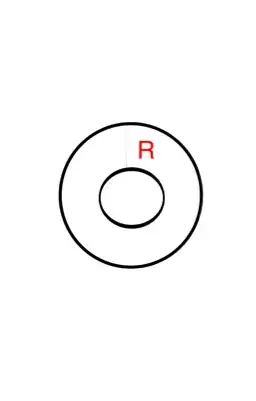
Let A be a circle of radius $r_a$ centered at the origin. Denote by $F(A)$ the transformation that maps A to a rectifiable curve. This curve $A_0$ has a single valued distance to the origin for each angle $\theta$ denoted by $r_{a0}$. Let, the perimeter of A be invariant under F.
Let B be a circle of radius $r_b$ centered at the origin. Denote by $F(B)$ the transformation that maps B to a rectifiable curve. This curve $B_0$ has a single valued distance to the origin for each angle $\theta$ denoted by $r_{b0}$. Let the perimeter of B be invariant under F.
In general, F is a mapping of the space $\mathbf(R)^2 \rightarrow \mathbf(R)^2$ such that a circle $Q_z$ of radius z and length $L(Q_z)$, under F maps to $Q_{z0}$ with $L(Q_z)=L(Q_{z0})$. For each angle $\theta$, $Q_{z0}(\theta)=\lambda \cdot Q$ where $\lambda$ is an arbitrary vector. We impose that the absolute value of $\lambda$ be contsant. Since the function $\lambda$ is arbitrary and $| \lambda |$ is constant, the perimeter of the resulting shape can be equal to the original. This means F is homogenous as $F(k \cdot B)=k \cdot F(B)$.
$A_0$ and $B_0$ can be parametrized by $x_a(\theta)$; $y_a(\theta)$ and $x_b(\theta)$; $y_b(\theta)$ since the Euclidean distance at $\theta$ is single valued.
Given F(B), F(A) may be constructed as follows. Extend a normal vector of length $r_a-r_b$, from the open side of F(B). F(A) is the end of this vector. Since $F(B)$ and $F(A)$ are functions of $\theta$, $A_0(\theta)$ is the end point of the normal vector extended from $B_0(\theta)$. This procedure is done for all $\theta \in (0,2\pi)$. If two normal vector extensions from $F(B)$ intersect, there is no $F(A)$ that is non-self-intersecting.
The perimeter of $F(A)$ equals the perimeter of A.
Proof: Since, $A$ is a scalar multiple $e$ away from $B$, because they're both circles.
$$e \cdot B=A$$
Because F is homogeneous,
$$e \cdot B_0=A_0$$
In addition,
$$e \cdot L(B)=L(A)$$
Similarly,
$$e \cdot L(B_0)=L(A_0)$$
By definition, $L(B)=L(B_0)$, therefore
$$L(A_0)=e \cdot L(B_0)=e \cdot L(B)=L(A)$$
The construction of $F(A)$ from a specified $F(B)$ is complete.
$$L(A)=L(B)+2 \pi r$$
Where $L(A)$ is the perimeter of A. This holds from the formula $C=2 \pi r$. $A_0$ and $B_0$ have the same perimeter as $A$ and $B$, respectively.
Therefore,
$$L(A_0)=L(B_0)+2\pi r$$
QED
Discussion
This does not cover every case. For instance, the theorem only works if the curvature is small compared to the differential $r$.
Mathematically I conjecture,
$$r \lt -min(1/\kappa(\theta))$$
Where $\kappa$, denotes the curvature, must hold for the theorem to hold.
I'm guessing this can't be generalized away.