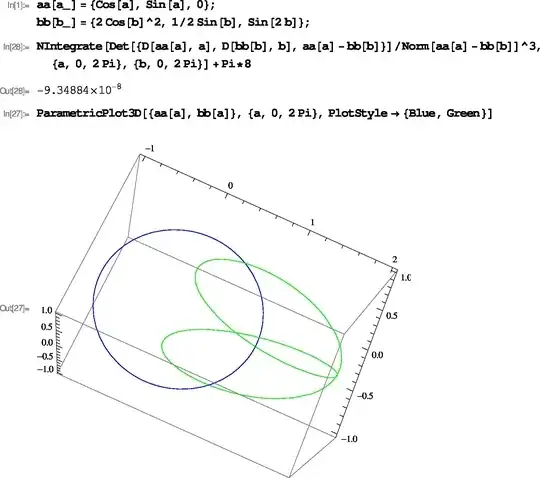
We find in Arnold's Trivium the following problem, numbered 39. (The double integral should have a circle through it, but the command /oiint does not work here.)
Calculate the Gauss integral
$$\int \int \frac{(d\vec A, d\vec B, \vec A-\vec B)}{|\vec A-\vec B|^3},$$
where $\vec A$ runs along the curve $x=\cos \alpha$, $y=\sin \alpha$, $z=0$, and $\vec B$ along the curve $x=2\cos^2 \beta$, $y=(1/2)\sin \beta$, $z=\sin 2\beta$.
First, what exactly is being asked here? We seem to have an inner product in the integral, except there are three arguments. I am not sure what to make of this -- the notation is unfamiliar to me. And I suppose $\alpha$ and $\beta$ both independently run from $0$ to $2\pi$?
Second, how does one solve this?
Update: David H. reports that the three-place function is probably the vector triple product. "More likely it represents the vector triple product. This is the integral one must evaluate to compute the magnetic force between two current-carrying wires." This interpretation makes sense, because these problems are directed physics students.