1

Given, a symmetric $n*n$ matrix $G$ with 0,1 entries. Each row of has same number of 1. $G$ is arranged in a certain order using a rule. The rule is described below-
$G$ is partitioned in to two sub matrices based on the adjacency of $n$ th column/row(column=row since it is a symmetric matrix).

e.g. n=10 for below matrix,10th vertex partitioned the whole matrix into 2 parts(matrices ),
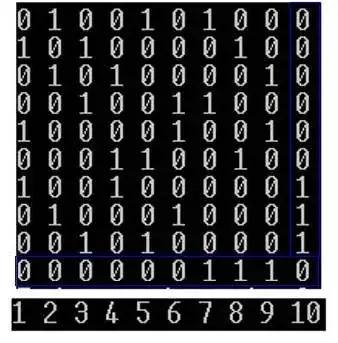
enter image description here

Vertices which are adjacent to 10th vertex(7,8,9 in one part) and vertices which are not (1,2,3,4,5,6 in other part ). enter image description here
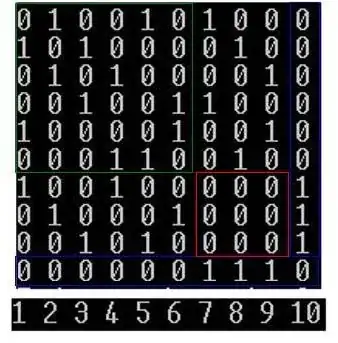
After repetition, the final picture would be,

enter image description here

Question: If $H$ is a permuted $G$, (i.e. $H=P G$ ,where P is a permutation matrix), following the given rule, how many combinations require to check(minimum number) to ensure that H is a permuted G?
i.e if $H$ is not a permuted $G$,how many combinations require to check(minimum number) to ensure that H is not a permuted G?

Michael
  • 547
  • 1
    suggest trying to describe your problem completely/ rigorously without examples 1st.... and then clearly showing how the examples fit the math operations.... – vzn Jun 18 '15 at 18:27
  • I'm not sure this is as completely described as you think. What do you mean by "$G$ is partitioned in to two sub matrices based on the adjacency of $n$ th column/row". How do you determine which cols/rows are adjacent to the $n$th col/row? Note, too, that if $H=PG$ where $P$ is a permutation matrix, then $H$ is obtained by just permuting the rows of $G$, so may not be symmetric itself. Does this matter? After partitioning $G$ do you permute something? – user642796 Jul 28 '15 at 15:40
  • 1
    Also, some motivation for this may be in order. Is this just an interesting something that you thought of? Do you have some application in mind? – user642796 Jul 28 '15 at 15:40

0 Answers0