2

The following problem is a detail from a proof I wrote recently -- a detail that I left unproven, and would like to prove.

Let there be three points $a$, $b$, and $c = \frac{a+b}{2}$, with $a<b$. We have a function $f$ such that $f(a) < f(c) \leq \frac{f(a)+f(b)}{2} < f(b)$.

So we can draw a line from $(a,f(a))$ to $(b,f(b))$ and the point $(c,f(c))$ will be on or below that line.

We then claim that the slope of the line from $(a,f(a))$ to $(c,f(c))$ is less than or equal to the slope of the line from $(c,f(c))$ to $(b,f(b))$. Why is this true? The intuition is clear to me, but I don't know how to formalize this.

A diagram below for clarity.
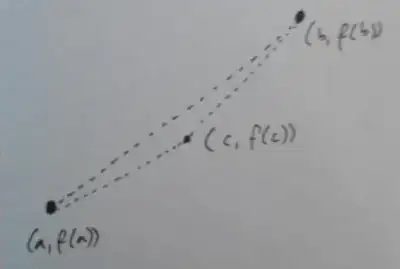
enter image description here

No matter how we place $f(c)$, the point $(c,f(c))$ will clearly always be such that the slope from $(a,f(a))$ to $(c,f(c))$ is less than the slope from $(c,f(c))$ to $(b,f(b))$ -- if this were not the case, then the point $(c,f(c))$ would have to lie above the line from $(a,f(a))$ to $(b,f(b))$. But how do I prove this?

Newb
  • 17,987
  • 14
  • 70
  • 116

2 Answers2

2

Edit: I misunderstood the question and will prove the actual question while leaving what I initially understood to be the question below.

We want to show that $(f(b) - f(c))/(b-c) \geq (f(c) - f(a))/(c-a)$.

Note: $(b-c) = (c-a) = (b-a)/2$

The inequality holds as $f(c)$ is at or below the midpoint of $f(b) - f(a)$


We also show that the slope of the line from $(a, f(a))$ to $(b, f(b))$ is larger or equal to the slope from $(a, f(a))$ to $(c, f(c))$.

To do this we must show that $(f(b) - f(a))/(b-a) \geq (f(c) - f(a))/(c - a)$.

Note that $c = (a + b)/2$

Substituting into the right hand side of the inequality yields $(f(b) - f(a))/(b-a) \geq 2(f(c) - f(a))/(b - a)$

We know the inequality holds as $f(c) - f(a)$ is strictly less than $f(b) - f(a)$ and $f(c)$ is at or below the midpoint of $f(a)$ and $f(b)$ so $2(f(c)-f(a)) \leq (f(b) - f(a))$

nSheahan
  • 126
  • Hold on -- I think you misunderstood. We want to show that $(f(b)-f(c))/(c-b) \geq (f(c)-f(a))/(c-a)$. – Newb Apr 09 '15 at 01:35
1

Note that this property implies that for any $t=\dfrac m{2^n}$, we have $f(ta+(1-t)b)\le tf(a)+(1-t)f(b)$. If $f$ is continuous, this implies $f$ in convex, and it is easy to prove the slope of chords that have one extremity at $A$, $\dfrac{f(x)-f(a)}{x-a}\,$ is a non-decreasing function of $x$.

So your assertion results from the fact that $f$, ig continuous, is a convex function.

Bernard
  • 179,256
  • That property can result from a nonconvex function....the problem only specified that the value for the midpoint was below the straight line average. In betweeen we can have all kinds of sinusoidal up and downs and still be continuous (or smooth or whatever) (unless this property is asserted to hold for ANY a and b, rather than a specific a and b, which is unclear from the OP). – Alan Apr 09 '15 at 02:20
  • If it i holds for any $a$ and $b$, there remains it is the convexity property on a dense subset. Noticing such connections mat be useful. – Bernard Apr 09 '15 at 08:06