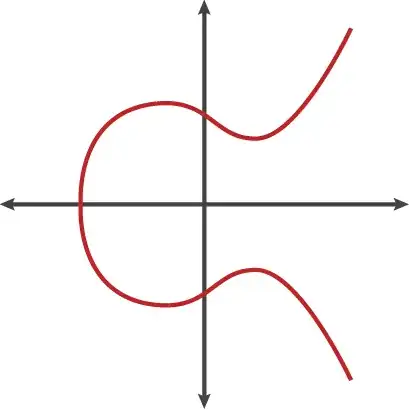
I am trying to understand the genus of an algebraic curve in the complex plane $\mathbb{C}P2$. I am looking for a visual or intuitive understanding. The difference between a sphere and a torus as a surface of genus 0 and 1 resp. is clear, but how does the surface relate to the planar curve?
As an example take the following parametrization: $$ t \in \mathbb{C} \mapsto (x,y,z) := (t+t^3, t-t^3, 1+t^4) \in \mathbb{C}P2 $$ Where $(x,y,z)$ are complex homogeneous coordinates, i.e. $(x',y') := (x/z, y/z) $ would be "normal" complex coordinates.
The parameter $t$ is $\in \mathbb{C}$ so one may regard the parameter $t$ on a Riemann sphere, where some points on the sphere are singular.
Is that the reason the genus of this curve is $0$, because it has a parametrization on a Riemann sphere?
Wikipedia claims that the Cassini ovals are curves of genus 1.
However the lemniscate is of genus 0.
I am inclined to believe that the Cassini oval looking like an ellipse is also genus $0$. Is that correct?
It could be that the Cassini oval consisting of two seperate parts is of genus 1. Is one part of the two seperate ovals then of genus $0$?