5

I need to obtain a closed form of $M(t)$, satisfying the following recurrence equation:

$$M(t+1)=a+bM(t)+\frac{c}{t+1}\sum_{t'=0}^tM(t')+df(t)$$

Where $f(t)$ is a known function and $a$, $b$, $c$ and $d$ are known constants. And with the initial condition $M(t=0)=0$.

I've never solved an equation of this kind, so I'm asking for a known analythic method for obtaining a closed form of the function $M(t)$. Maybe a reference book may help, or just the name of one method of solution.

Tom-Tom
  • 7,017
Ana S. H.
  • 953
  • 1
    Would [math.se] be a better home for this question? – Qmechanic Mar 11 '15 at 17:10
  • @Qmechanic Maybe, I posted the question here because we, physicist, can solve equations heuristically or exactly. But answering your question: yes, it would be better. – Ana S. H. Mar 11 '15 at 17:13
  • 1
    Comment to the question (v3): If $t=0$ then you are dividing with zero on the rhs. – Qmechanic Mar 13 '15 at 00:32
  • @Qmechanic You're right. I made a mistake trying to write the general form of the equation. The correct expression of the coefficient of the sum is $c/(t+1)$. – Ana S. H. Mar 18 '15 at 02:38
  • 1
    Do you have other boundary conditions? – Alex R. Mar 18 '15 at 02:44
  • @AlexR. I just have an initial condition: $M(t=0)=0$. – Ana S. H. Mar 18 '15 at 17:07
  • 2
    Observe that $(t+1)M(t+1)-tM(t)=a+(t+1)bM(t)-tbM(t-1)+cM(t)+(t+1)df(t)-tdf(t-1)$. After reduction one gets $M(t+1)=A(t)M(t)+B(t)M(t-1)+C(t)$, where $A(t)=\frac{t(b+1)+b+c}{t+1}, B(t)=-\frac{tb}{t+1}, C(t)=\frac{a+d((t+1)f(t)-tf(t-1))}{t+1}$. – Marcin Malogrosz Mar 18 '15 at 17:50
  • Why always the quest for "closed forms"? They are the exception, not the rule! The numerical equivalent of the function $M(t)$ would be a simple program that can be written by the OP himself, without doubt.What's the big deal? – Han de Bruijn Apr 18 '15 at 09:51
  • You intend for $M$ to really be a discrete sequence of values, not a continuous function, correct? – rajb245 Apr 19 '15 at 15:20
  • 1
    Also, why the nonlinear system tag? There are no nonliear functions of $M$ in this. Although one coefficient depends nonlinearly on $t$, this does not make a nonlinear system. – rajb245 Apr 19 '15 at 15:25
  • Indeed,as @HandeBruijn asks, what is the purpose of finding a closed form solution? The numerical algorithm, unlike that for a differential equation which gives only approximate solution, give the exact solution. Are you looking for some asymptotic or other qualitative properties that can not be precisely produced by numerical methods? – Hans Apr 19 '15 at 20:25
  • 1
    @rajb245. In some sense, it is a linear equation since all terms depend on $M^\alpha$ with $\alpha=0$ or $1$. If you let $a=d=0$, then the solutions form a vectorial space, it is easy to check that. Therefore the solution in the general case belongs to an affine space. – Tom-Tom Apr 21 '15 at 08:37
  • If $a=d=0$, then $M(t)=0$ for all $t$. – san Apr 22 '15 at 00:36
  • @san. Yes, of course, because it is linear and $M(0)=0$. If you you chose $M(0)=1$, you get a solution which is not always zero, let us call it $m$. If you chose $M(0)=\alpha$, you get the solution $\alpha m$. So, it's a linear equation. – Tom-Tom Apr 22 '15 at 07:58
  • @Tom-Tom we agree, it's a linear system with forcing; the case $a=d=0$ is the unforced linear system, and $a+df(t)$ is the forcing term. – rajb245 Apr 22 '15 at 14:00

2 Answers2

3

There is, I fear, not much to be done for lower values of $t$. But the asymptotics for $t\to\infty$ could reasonably be estimated, depending on the values of the parameters. For instance, if $b>0$, write $h(t)=tb^{-t}M(t)$ and consider the functional equation $$h(t+1)=\frac{t+1}th(t)+(t+1)b^{-t-1}\left(a+df(t)\right)+\frac cb \frac {t+1}{t}\int_0^tb^{u-t}h(u)\frac{\mathrm du}u$$ which is equivalent to your recurrence equation. As $t\to\infty$, one can expand $h(t+1)$ to the first order and neglect the second order terms in $t$ (i.e. using $t+1\simeq t$) and get a more addressable equation $$h'(t)=tb^{-t}\left(a+df(t)\right)+\frac cb\int_0^tb^{u-t}h(u)\frac{\mathrm du}u.$$

From there, everything depends on the function $t\mapsto tb^{-t}\left(a+df(t)\right)$. It is impossible to say something general and you will probably have to distinguish cases, that is find which term is leading the asymptotic behaviour.

However, in the case the function $t\mapsto tb^{-t}(a+df(t))$ is bounded you can use Grönwall's inequality to bound the solution. Let us say that $tb^{-t}(a+df(t))$ is between $A>0$ and $B>0$ for sufficiently large $t$. Since the antiderivative of $u\mapsto b^u/u$ is $u\mapsto\mathrm{Ei}\left(u\log b\right)$, you get the asymptotic behaviour of $h$ as roughly $h(t)\sim \exp\left(\frac cb \mathrm {Ei}(t \log b)\right)$ which gives $$M(t)\sim \frac{b^t}t\exp\left[\frac cb\mathrm{Ei}\left(t\log b\right)\right].$$ The leading constant would be in that case a number between $A$ and $B$.

Tom-Tom
  • 7,017
2

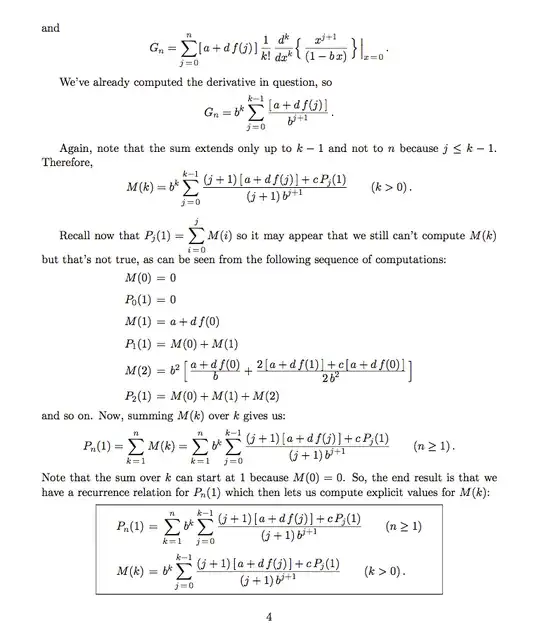
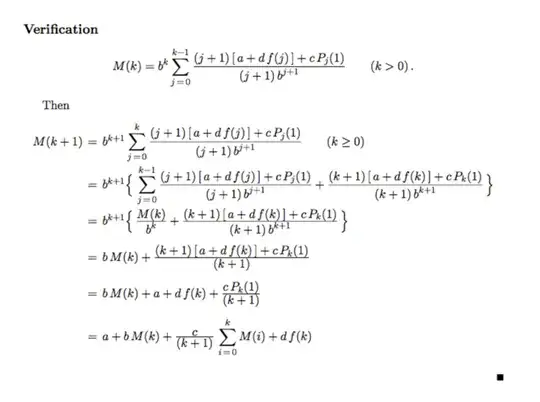
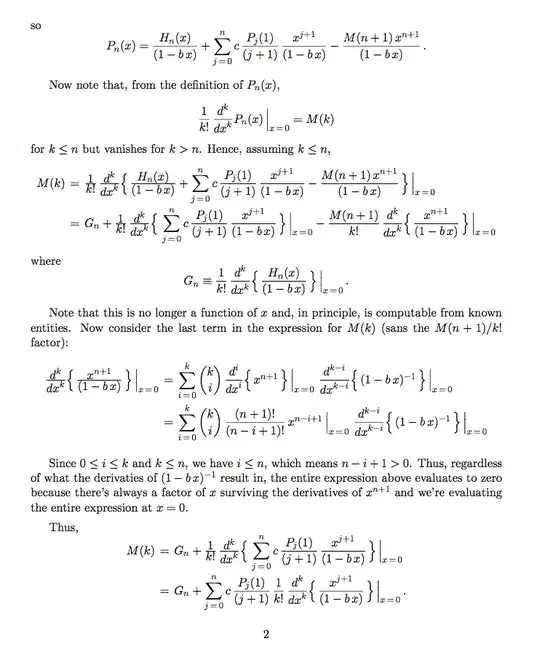
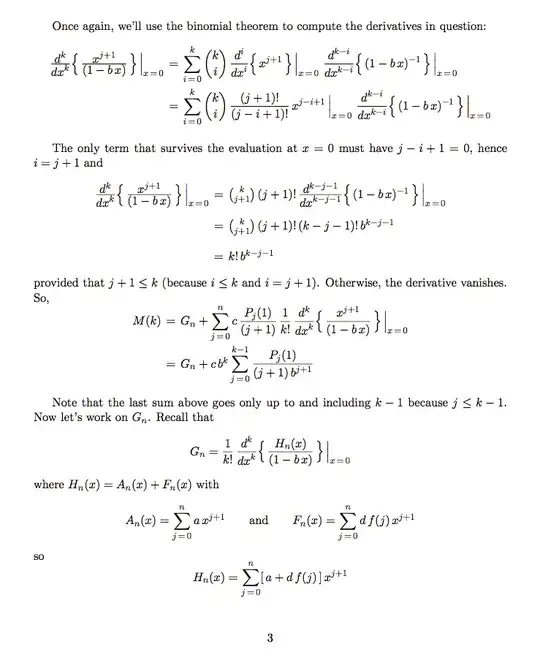
I have an explicit solution, which I obtained by using the method of generating functions. First, compute what I called $P_n(1)$ from a recurrence relation. Then use those to compute explicit values of $M(k)$. $P_n(1)$ is the sum of the $M(k)$ values, for $0 \le k \le n$. You don't even need to compute all $P_n(1)$ values ahead of time. You can compute the $P$'s and the $M$'s in alternation (one $P$, one $M$, one $P$, one $M$, etc).

$ \begin{array}{rcl} P_n(1) &\!\!\!=&\!\!\! \sum_{k\,=\,1}^{n} b^k \sum_{j\,=\,0}^{k-1} \frac{\displaystyle (j+1)\,[\,a + d\,f(j)\,] + c\,P_j(1)}{\displaystyle (j+1)\,b^{j+1}} \qquad (n \ge 1) \\[0.2in] % M(k) &\!\!\!=&\!\!\! b^k \sum_{j\,=\,0}^{k-1} \frac{\displaystyle (j+1)\,[\,a + d\,f(j)\,] + c\,P_j(1)}{\displaystyle (j+1)\,b^{j+1}} \qquad (k>0)\,. \end{array} $

Now, the proof of this result took me 4 pages of LaTeX, with lots of macros of my own that are not supported by the LaTeX engine here so I'm not sure what the best way to share that proof is. For now, I'm going to post screen shots.

enter image description here

enter image description here

enter image description here

enter image description here

enter image description here

wltrup
  • 4,073
  • This is a good idea to use a generating function. But unfortunately this solution requires computing $P_n(1)$ step by step using the first formula in the frame, and the recurrence on $P_n$ belongs actually to the same class as the initial recurrence on $M$. So I see little improvement. – Tom-Tom Apr 20 '15 at 12:55
  • One step at a time... I'm working on solving the recurrence for $P_n(1)$. :) – wltrup Apr 20 '15 at 12:58
  • No luck so far in regards to solving the recurrence for $P_n(1)$. And not for lack of trying! – wltrup Apr 20 '15 at 16:41
  • I've been trying to sum up the generating function with infinite $n$. I get a pretty weird functional equation (using your notations and $|z|<1$) $$P(z)=\frac{H(z)}{1-bz}+c\int_0^z \frac {P(z)}{u(1-u)\ln\frac zu}\mathrm du.$$ Maybe there is something to do from there, but I really can't see what. – Tom-Tom Apr 21 '15 at 08:25
  • I worked on that for a few hours yesterday, to no avail. I'm afraid there's no way to solve this problem analytically. As someone commented in the original question, the original recurrence can be cast into a non-homogeneous 2nd-order recurrence with non-constant coefficients, $M(k+1) + a_k,M(k) + b_k,M(k-1) + c_k = 0$. I couldn't find any references on the web on solving those analytically so I doubt anyone will be able to solve for $M(k)$ or $P_n(1)$ separately. I'd love to be wrong on that opinion, though. – wltrup Apr 21 '15 at 08:32
  • Don't you mean $P(u)$ inside the integral? – wltrup Apr 21 '15 at 08:47
  • Yes, sorry for the typo. I can't edit anymore. – Tom-Tom Apr 21 '15 at 08:54
  • Perhaps it's worth pointing out that the equation you found for $P(z)$ is a linear Volterra equation of the second kind, not the easiest beast to tame, generally. Maybe this one's kernel has nice enough properties to allow for an analytical solution but I wouldn't be surprised if that's not the case. – wltrup Apr 21 '15 at 09:52