9

Why is this no triangulation of the Klein Bottle?
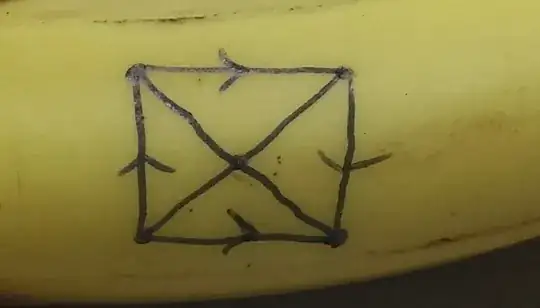
enter image description here

Is it because the top and the bottom triangle share 3 vertices but have different edges?

How do I find a triangulation?

azimut
  • 24,316

1 Answers1

5

The vertices of the outer square do not remain distinct after identifying edges to create the Klein bottle. So some of your "triangles" have less than $3$ vertices.

Jim
  • 31,547
  • Thanks, I understand. Will this work as a triangulation? http://i.imgur.com/Vso6w0U.jpg All the triangles are actually triangles here. – iwriteonbananas Feb 20 '15 at 10:47
  • Yea, now there's no problem. – Jim Feb 20 '15 at 16:29
  • Are you sure? There are two different lines between the points 2 and 3 : http://i.imgur.com/KL1FHap.jpg Is that possible in a simplicial complex? – iwriteonbananas Feb 20 '15 at 18:18
  • 1
    Yes, that's possible. Every triangle has $3$ distinct vertices, $3$ distinct edges, and the intersection of any two triangles is either a single vertex or a single edge. That's all you need. – Jim Feb 20 '15 at 18:57
  • 1
    This is late, but @iwriteonbananas new triangulation is not a simplicial complex for the klein bottle, either. There are not enough vertices; for example, there are two different lines between point 3 and the middle vertex. Also, once everything collapses, the edge 12 is shared by four distinct triangles. If you actually write out the edges and triangles for the complex, it ends up being four discs identified at their boundaries. – Caleb Stanford May 07 '15 at 20:56
  • @Jim Can you please clarify whether you are disagreeing with 6005? It seems like one person is saying distinct vertices can't have more than one edge joining them in a simplicial complex, and the other person is saying you can. Is this allowed or not? – Smithey Nov 22 '15 at 05:41
  • I disagree, but we may be talking about two different things. When he says edge 12 is shared by 4 triangles I think that means he's identifying all four edges of the square. I'm only identifying the top/bottom edges with themselves and the left/right edges with themselves. I see now this isn't explicit in the OP's picture, but it makes the answer correct and it's what I assume he meant. – Jim Nov 22 '15 at 15:32