5

If we build a $10\times10$ matrix, randomly filling with $1$'s and $0$'s, is it more likely to be invertible or singular?

First of all until we have 10 $1$'s it's not going to be invertible.
With 10 $1$'s on the diagonal, we can make many lower and upper triangular matrices, each of which will be invertible.

But I'm not finding a way to proceed.

hbghlyj
  • 5,361

2 Answers2

2

Over $\mathrm{GF}(2)$, the number of invertible $n \times n$ $(0,1)$-matrix is given by $$\prod_{k=1}^n (1-2^{-k}).$$ See this math.SE answer for the argument. Hence the probability of invertibility is approximately $0.289$.

The answer is much harder over the rationals (or equivalently reals). There's some asymptotic results discussed on the above-linked page. It seems the exact number is not known for $10 \times 10$ since it's not listed on the OEIS: http://oeis.org/A046747.

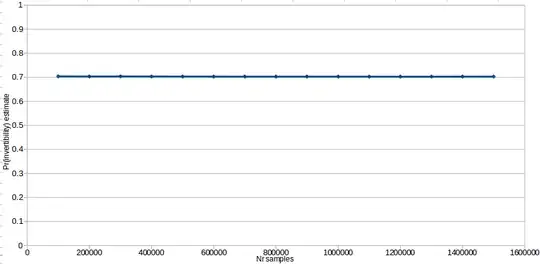
Experimentally, you can be fairly certain that the probability is $>0.5$ (i.e., more likely to be invertible). The following figure plots an estimate of the probability as the number of samples increases:

estimate of probability

1

Rebecca gave a good answer. Let $P_d$ be the probability that your $d\times d\;\;$ $0-1$ matrix is SINGULAR. Then it is known (Kahn,Komlos,Szemeredi) that $P_d$ tends to $0$ when $d$ tends to $\infty$. Tao and Vu give an estimate (2005) $P_d=(3/4+o(1))^d$. Yet, for $d=10$ (a small number), the various known estimates are absolutely useless. Numerical experiments show that $P_{10}\approx 0.297$, but the exact value seems to be unknown.

Yet, the possible values of $\det(A)$ when $A$ is a $10\times 10\;\;$ $0-1$ matrix are known (Orrick) ; cf. http://mypage.iu.edu/~worrick/slides/SpectrumANU.pdf