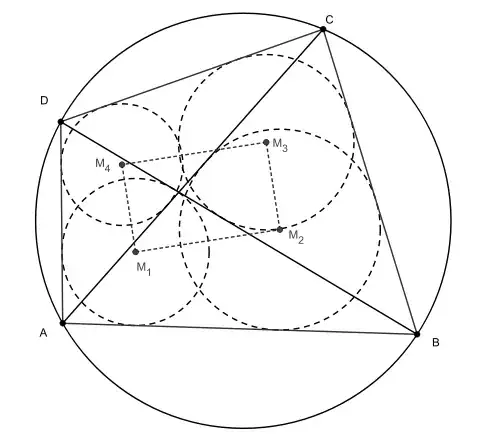
Some very ugly symbol-bashing led me to this relation:
$$\sin\alpha \sin\gamma = \sin \beta \sin\delta$$
Edit. Proof (without much symbol-bashing at all!) begins with a lemma about inscribed and circumscribed circles.
Lemma. Let $I$ be the incenter of $\triangle ABC$, and let $A^\prime$ be the point where $\overrightarrow{AI}$ meets the circumcircle of $\triangle ABC$. (Note that $A^\prime$ is the midpoint of $\stackrel{\frown}{BC}$.) Then $$|\overline{A^\prime I}| = |\overline{A^\prime B}| = |\overline{A^\prime C}| = 2 r \sin\frac12 \angle A$$ where $r$ is the circumradius.
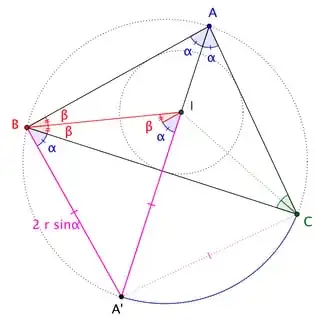
Proof of Lemma. The bisectors of $\angle A$ and $\angle B$ (and $\angle C$) meet at $I$, so we can write
$$\alpha := \angle BAA^\prime = \angle CAA^\prime = \frac12\angle A \quad\text{and}\quad \beta := \angle ABI = \angle CBI = \frac12\angle B$$
The Exterior Angle Theorem applied at vertex $I$ of $\triangle ABI$ implies that $\angle BIA^\prime = \alpha + \beta$.
The Inscribed Angle Theorem implies that $\angle A^\prime B C = \angle A^\prime A C = \alpha$, as both angles subtend the common arc $\stackrel{\frown}{A^\prime C}$. Therefore, $\angle IBA^\prime = \alpha + \beta$.
Consequently, $\triangle IBA^\prime$ is isosceles with base $IB$.
The Law of Sines implies that $|\overline{A^\prime B}| = 2 r \sin\alpha$, so this must also be the length of $\overline{A^\prime I}$.
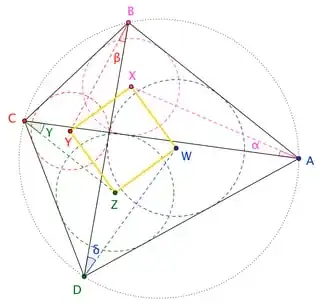
Lemma in hand, we return to the original problem, with cyclic quadrilateral $\square ABCD$ determining incircles with centers $W$, $X$, $Y$, $Z$ as shown.
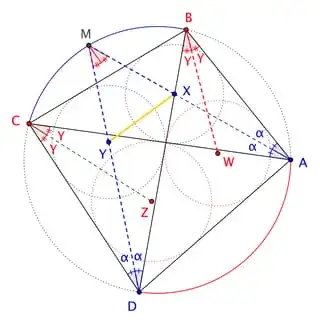
With $M$ the midpoint of $\stackrel{\frown}{BC}$, we observe that rays $\overrightarrow{AX}$ and $\overrightarrow{DY}$ converge at $M$. By the Lemma, with $r$ the radius of the circle,
$$|\overline{MX}| = 2 r \sin\alpha = |\overline{MY}|$$
Moreover, since inscribed angles $\angle ACD$ and $\angle AMD$ subtend $\stackrel{\frown}{AD}$, they are congruent, so that the vertex angle of isosceles triangle $\triangle XMY$ has measure $2\gamma$. Therefore,
$$|\overline{XY}| = 2 r \sin\alpha \sin\gamma \qquad\text{and, likewise,}\qquad |\overline{WX}| = 2 r \sin\beta \sin\delta$$
with $\beta$ and $\delta$ as in the first diagram above. Note that, by symmetry, $|\overline{WZ}| = 2r\sin\alpha\sin\gamma$ and $|\overline{YZ}| = 2r\sin\beta\sin\delta$. We have almost proven the Japanese theorem itself, since $\square WXYZ$ is now at least a parallelogram. Taking rectangle-ness for granted, we see that $\square WXYZ$ is more specifically a square if and only if two adjacent sides are congruent; this is precisely the condition
$$\sin\alpha\;\sin\gamma \;=\; \sin\beta\;\sin\delta$$
as claimed. $\square$