I think that the problem is ill-defined as it stands. The answer to the second question (i.e., the probability of winning upon switching) depends on (1) what door-opening policy the host uses; and (2) what switching policy the player uses.
If one implicitly assumes that the player selects randomly with equal probability of $1/3$ from the three other unopened doors upon considering switching, then the probability of winning is $4/15$, indeed, as other answerers pointed out. This can be seen to be true irrespective of how the host selects which door to open.
However, consider the following scenario. Without loss of generality, suppose that the player chooses door $A$. The host uses the following door-opening policy:
- If the prize is in $B$, open door $C$.
- If the prize is in $A$, $C$, $D$, or $E$, open door $B$.
The player uses the following switching policy:
- If $B$ is opened by the host, switch from $A$ to $C$;
- If any other door is opened by the host, switch from $A$ to $B$.
Given the host's door-opening policy, there are five relevant states of the world, each occurring with probability $1/5$:
- The prize is in $A$, the host opened $B$.
- The prize is in $B$, the host opened $C$.
- The prize is in $C$, the host opened $B$.
- The prize is in $D$, the host opened $B$.
- The prize is in $E$, the host opened $B$.
Upon using the switching policy specified above, the player wins the prize upon switching in the second and the third of the five states. Hence, the probability of winning upon switching is $2/5>4/15$.
Therefore, the answer depends on how the host chooses which door to open and how the player selects which unopened door to switch to! This is because the player can infer some extra information from the particular door-opening policy the host uses. In the example above, if the player knows the policy the host uses, then she can be sure that the prize is behind door $B$ upon observing door $C$ having been opened! This extra information improves the player's chance of winning the prize upon switching.
Note that this complication does not arise in the basic Monty Hall problem with only three doors. If the player selects $A$ (again, with no loss of generality), then the host has a choice of which door to open only if the prize is in $A$. This is immaterial, though, since in this case the player surely loses upon switching. Hence, if the prize is in $A$ (probability $1/3$), then the player loses if she switches (irrespective of which other door the host opens) and if the prize is in either $B$ or $C$ (probability $2/3$), then the player surely wins if she switches (since the host is constrained to leave the winning door unopened).
Accordingly, any extra information that may be contained in the host's door-opening policy is useless for the player considering which door to switch to (conditional on having decided on switching). If the prize is behind $A$, then she won't win anyway upon switching, and no extra information can help this. If the prize is behind $B$ or $C$, on the other hand, then she will win even if the host's door-opening policy doesn't surreptitiously reveal any extra information.
With five doors, however, the specific details of how non-winning doors are opened by the host and how unopened doors are selected by the player do matter!
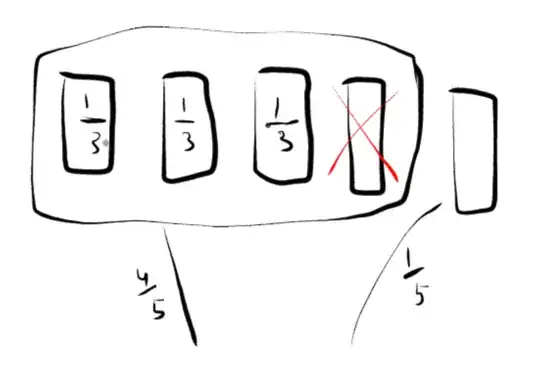
In fact, if the host really likes the player, he can make sure she wins with probability $4/5$ upon switching! To see this, suppose the host uses the following policy (again, wlog, assume that the player has chosen $A$):
- If the prize is in $A$ or $B$, open $C$.
- If the prize is in $C$, open $D$.
- If the prize is in $D$, open $E$.
- If the prize is in $E$, open $B$.
You can easily check that the player will win with probability $4/5$ if she uses the following policy:
- If $B$ is opened, switch to $E$.
- If $C$ is opened, switch to $B$.
- If $D$ is opened, switch to $C$.
- If $E$ is opened, switch to $D$.
This is because if the player knows the host's policy, then the host is basically “telling” the player where the prize is, as long as it is not in $A$.




___"Any proposed solution to the MHP failing to pay close attention to Monty’s selection procedure is incomplete"___ – Ankit Mar 29 '17 at 02:44