3

Recall that a language is $\omega$-regular if and only if it is recognized by a Büchi automaton. How can I prove that

$\qquad (E_1 + E_2).F^\omega$

is equivalent to

$\qquad {E_1.(F^\omega)+E_2.(F^\omega)}$

where

  • both expressions are omega regular expressions, and
  • $E_1$, $E_2$ and $F$ are arbitrary regular expressions with $\epsilon \notin L(F)$.

One way I could think of is to convert expression to a DFA and check if it is equivalent.

Or I will really appreciate a hint on how to do the equivalence proof, but how to represent $E_1$, $E_2$ and $F$ in DFA.

Juho
  • 22,905
  • 7
  • 63
  • 117

3 Answers3

6

As suggested by Raphael, here's a proof doing it via the sets represented by those expressions.

$\qquad L_\omega((E_1+E_2) \cdot F^\omega) \\= L(E_1+E_2) \cdot L_\omega(F^\omega) \\= (L(E_1) \cup L(E_2)) \cdot L_\omega(F^\omega) \\= \{w_1w_2 | w_1 \in (L(E_1) \cup L(E_2)) \wedge w_2 \in L_\omega(F^\omega) \} \\= \{w_1w_2|(w_1 \in L(E_1) \wedge w_2 \in L_\omega(F^\omega)) \lor (w_1 \in L(E_2) \wedge w_2 \in L_\omega(F^\omega))\}\\= \{w_1w_2|(w_1 \in L(E_1) \wedge w_2 \in L_\omega(F^\omega))\} \cup \{w_1w_2|(w_1 \in L(E_2) \wedge w_2 \in L_\omega(F^\omega))\} \\= (L(E_1)\cdot L_\omega(F^\omega)) \cup (L(E_2)\cdot L_\omega(F^\omega))\\=L_\omega(E_1 \cdot F^\omega) \cup L_\omega(E_2 \cdot F^\omega)\\=L_\omega(E_1\cdot F^\omega + E_2 \cdot F^\omega)$

So the only thing that's actual work here is to translate the logical operators into set operators.

G. Bach
  • 2,019
  • 1
  • 17
  • 27
3

The question has nothing to do with ($\omega$-)regular languages. Indeed, it is a consequence of the equality $$ (L_1 + L_2)L = L_1L + L_2L $$ which holds for all subsets $L_1, L_2$ of $A^*$ and all subsets $L$ of $A^\omega$. The proof is straightforward: if $w \in (L_1 + L_2)L$, then $w = uv$ for some $u \in L_1 + L_2$ and some $v \in L$. Thus either $u \in L_1$ or $u \in L_2$ whence either $uv \in L_1L$ or $uv \in L_2L$. In the opposite direction, if $w \in L_1L + L_2L$, then either $w \in L_1L$ or $w \in L_2L$. In the first [second] case, $w = uv$ for some $v \in L$ and some $u \in L_1$ [$u \in L_2$]. In both cases, $w \in (L_1 + L_2)L$.

J.-E. Pin
  • 6,219
  • 21
  • 39
2

We have to show that

$\qquad (E_1 + E_2).F^\omega = E_1.(F^\omega) + E_2.(F^\omega)$.

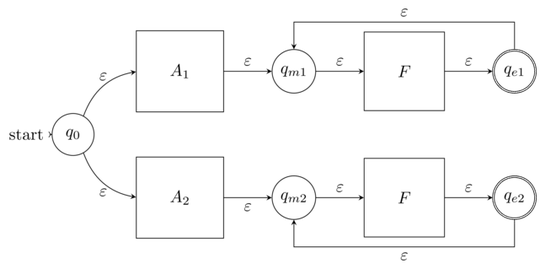
We have do to some preparation. $E_1, E_2$ and $F$ are regular expressions, so they have (deterministic) finite automata $A_1, A_2, A_F$. It is easy to see that we can construct NBA for the left and right hand side from those, respectively:
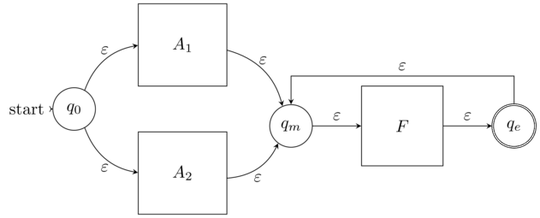
First automaton
[source]

Second automaton [source]

Showing that these are correct should be a simple exercise, given the proof for the equivalence of $\omega$-regular expressions and NBA you should have seen.

Note that the transitions going into the DFA connect with their respective initial states, while the outgoing one originate from their final states (w.l.o.g. there is only one in each DFA).

Now, as usual, show $\subseteq$ and $\supseteq$ separately. Both directions work in the same way; let's look at it for $\subseteq$.

Assume a word $w$ is in the language generated by $(E_1 + E_2).F^\omega$. Then, there is an accepting (infinite) path in above automaton. The same path basically works for the lower automatong: depending on whether the run goes through $A_1$ or $A_2$, replace $q_m$ with $q_{m1}$/$q_{m2}$ and $q_e$ similarly.

A similar construction works for $\supseteq$.

Raphael
  • 73,212
  • 30
  • 182
  • 400