So I'm currently studying theory of computation, and I was wondering if you could theoretically have more than one initial state in a DFA and if you can prove that a DFA with more than one initial state can depict a regular language? So essentially, can we prove that a language is regular if and only if it is accepted by a DFA with more than one initial state?
I was experimenting with the language L which consists of all strings over the alphabet {a,b} which contains an even number of a's.
I managed to draw a DFA for this language as well as my representation for a DFA with more than one initial state. From the looks of things, it makes sense.
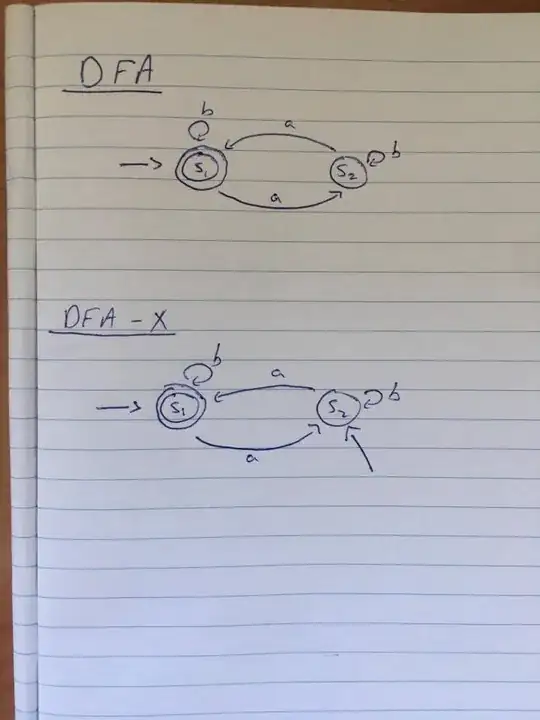
But is there any way that we can PROVE that a language is regular if it is accepted by a DFA with more than one state? So for any given DFA with more than one initial state, are the languages that it accepts is regular? If so, how can I prove it? I know from Kleene's Theorem that a regular language is accepted by an FA, but from the research I have done I have not been able to find anything regarding my question.

