I obtained my Operations Research degree from a military institution and have been using it for military applications for about 15 years. In that timeframe, Data Science has grown into a main-stream term referring to people with varying degrees of expertise in the data and information space. In the Department-of-Defense (DoD), Data-science is not very well defined, but yet, there is an understanding of wanting more of it, and there is an expectation that DS is crucial for data-architecting, data-normalization, ML, AI and facilitating analytics. Unfortunately, some decision makers perceive visualizations as being the end-state goal of analytics, but that is better left as a tangential discussion in the future.
Before DS became a main-stream term, Ops Researchers were used by the DoD to perform the data tasks that I mentioned above, but also to do Mathematical Programming, Optimization, Network optimizations (as in SCM, not computer networks), Network Interdiction and vulnerability analysis, and simulations for prediction and prescription, plus process testing and wargaming.
The Advances in Computer Science, Computer Hardware and Computing Power, plus the reduction of cost in those areas have now provided the necessary demand for a dedicated discipline to exploit data in the way that all our theories have only dreamed of since the era of vacuum tubes. I think for the most part ORs have been filling a void out of necessity, but not necessarily with the right standard discipline and expertise that it really merits. I don't mean to say that ORs can't do data science, or that we can't be experts on it. However, in my experience we (ORs) have been performing data-science tasks in order to support analytics (modeling, simulation, decision aides, etc...)
In general, and surprising, due to the age of the two disciplines, there is a better understanding in the Department-of-Defense of what Data Scientists do, than what ORs do. Probably because of the main-stream aspect of DS, and the current data-age we live in. To the sad and frustrating point where now OR has to defend its utility, since the wrong assumption is that DS can do all that ORs do.
The confusion is also due to the fact that Ops Research does not always produce a tool or data-product, but instead delivers analysis that may have used techniques that are not always advertised or highlighted as they are not the focus, but the results of the analysis itself. Also Ops Researchers tend to grow from a functional group and culture first, and then become ORs. This has a huge positive impact for the studies and analysis, but also does not give the ORs an obvious distinction within the team. Data Scientists, however, due to their "newness," average age and specific niche that they operate in, plus the fact that they can come in from outside the functional area and culture, they are automatically identified as an enabler and SME.
I hope that my experiences help answer the original questions or at least give a different perspective to better inform the group. I did not want to go technical as I think that there is a lot of overlap between the two disciplines, and we are all still trying to get better definitions as we settle in this space.
Cheers to the group,
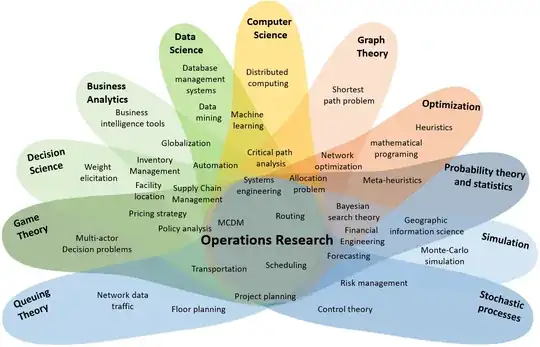
p.s. I find this graphic useful in illustrating OR: