6

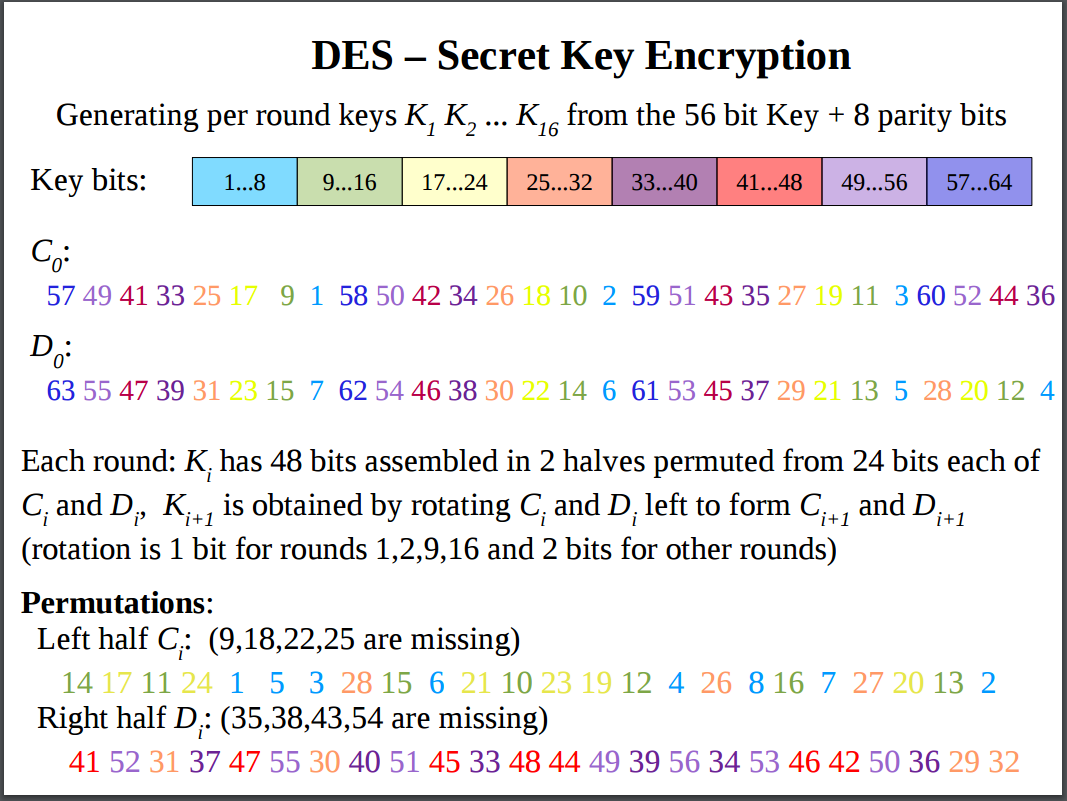
I am reading over a slide that I found online regarding the DES algorithm for encryption and I am a little confused about the per round key generation. From the slide below, I understand that each per round key is obtained by shifting left either 1 or 2 bits depending on the round. The thing I do not understand is the permutations for Left half C_i and right half D_i

In the slide, it says that the left half C_i is 14 17 11 24 1 5 3 28 15 6 21 19 23 19 12 4 26 8 16 7 27 20 13 2. Are the numbers in this example random? A textbook I am reading also uses the same numbers for round C_i and I cannot see the connection here. C_0 does not contain 14, so I am not really sure how left shifting bits causes the 14 from D to go to C. Am I misunderstanding the problem here?
Slide

Mike Edward Moras
  • 18,161
  • 12
  • 87
  • 240
Rowen McDaniel
  • 63
  • 1
  • 1
  • 3

1 Answers1

4

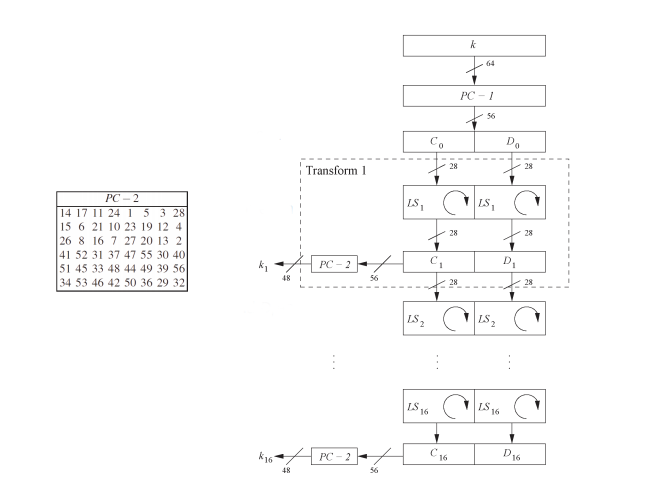
Numbers $\{14,17,11,24,1,5,3,\dots\}$ come from permuted choice PC-2. So let me explain 16 round DES key scheduling:

DES input key size is 64 bit which contains 56 bit key and 8 parity bits. Parity bits are 8th bit of every 8 bits (on byte). So they are all multiple of eight: $\{8, 16, 24, 32, 40, 48, 56, 64\}$. Permuted choice PC-1 is used to remove these bits from the 64 bit input key. So PC-1 gives 56 bits as output.

In round $i\ (1 \le i \le 16)$, there is a 56 bit input, $C_{i-1}$ as left half and $D_{i-1}$ as right half (each 28 bits). These two halves are rotated left (for decryption, right rotate is used). For encryption, rotate amount in rounds $\{1, 2, 9, 16\}$ is one and in other rounds it's two. For decryption, one bit right rotation in rounds $\{2,9,16\}$ and two bit right rotation in all other rounds. As inputs of rotation are $C_i$ and $D_i$, outputs of rotation are $C_{i+1}$ and $D_{i+1}$ which are passed to the next round ($i+1$) as input.

After all, in round $i$ there is a 48 bit output, named $K_i$. This sub key is generated from permuted choice PC-2, which takes $C_i$ and $D_i$ as a 56 bit input and outputs the sub key.

Now i think now you understood where those numbers come from. The overall process is illustrated in the picture below (Encryption):

DES encryption

Image Source: Understanding Cryptography by Christof Paar and Jan Pelzl, Chapter 3

Mehran Torki
  • 302
  • 2
  • 13